From Point Clouds to Pathogen Ecology: Building a Measurement Stack for Vineyard Health
Structural phenotyping, stress biomarkers, and residue microbiome ecology are converging into a practical measurement stack for grapevine disease research and management.

Prem Pratap Singh
March 5, 2026 · 6 min read
Plant research keeps getting pulled in two directions at once: toward ever more detailed biology (omics, host-pathogen dynamics, stress physiology) and toward ever more scalable measurement (imaging, automation, field-ready phenotyping). Today's reading list is a reminder that the most useful advances often sit at the interface, where we can translate complex plant states into measurable signals, and then use those signals to make better decisions in vineyards and beyond.
Why this matters
For grapevine systems in particular, the practical questions are deceptively simple: Is the plant stressed? Where is the canopy architecture limiting productivity or disease management? How do pathogens persist between seasons? Yet each question spans multiple scales, molecular responses, organ-level structure, and field-level epidemiology.
Three threads connect the sources I reviewed:
-
Stress is measurable if we choose the right representation. A gene-expression biomarker approach to plant water status highlights how physiological state can be inferred from molecular readouts across controlled and natural environments, suggesting a path from 'omics signal' to actionable stress monitoring.
-
Pathogen pressure is shaped by ecology and scale, not just the pathogen. Work on crop residues frames residues as an 'ecotone' between plant and soil where microbiomes influence pathogen survival, an important reminder that disease management is not only in-season but also off-season. Complementary modeling on spatial scale and pathogen fitness reinforces that what we observe (and what we can control) depends strongly on the spatial resolution of our interventions.
-
Structure is becoming a first-class dataset. Grapevine structure extraction from high-resolution point clouds, and pruning-point detection via 2D plant modeling and segmentation, both point to a near-term future where canopy architecture is quantified routinely. For grapevine virology and plant-pathogen interactions, structure matters because it mediates microclimate, spray penetration, and contact networks that can influence disease spread.
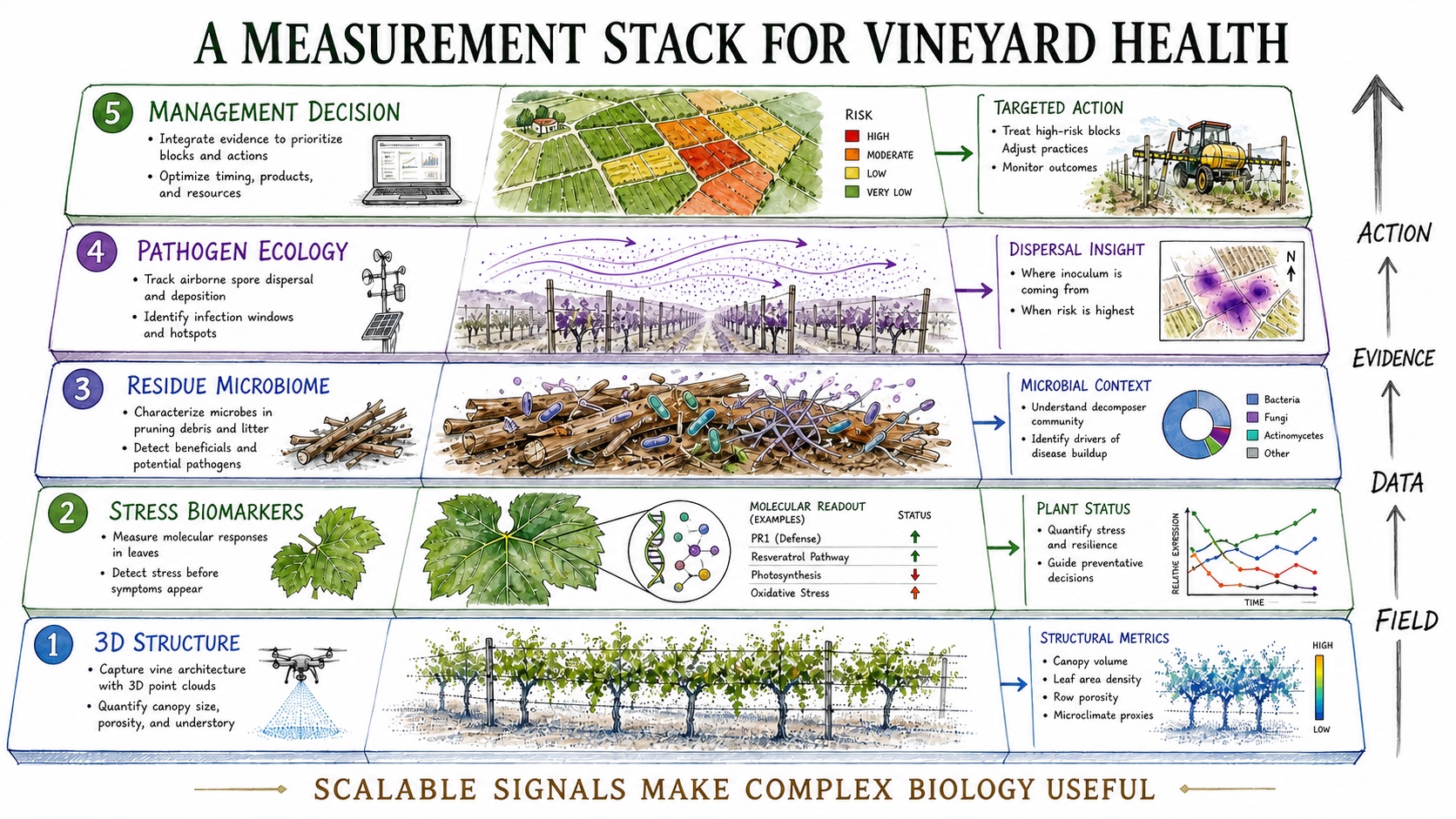
Taken together, these directions support a more integrated 'measurement-to-mechanism' loop: quantify plant state and structure, interpret them through models of stress and pathogen dynamics, and then feed that back into management decisions.
What changed today
The most concrete 'today' change is not a single breakthrough result, but a convergence: the measurement stack for grapevine architecture is maturing while plant stress and pathogen ecology models are becoming more operationally relevant.
On the measurement side, the point-cloud work on accurate 3D grapevine structure extraction emphasizes that high-resolution geometry can be reconstructed in a way that is usable for downstream tasks (e.g., canopy metrics, structural traits). In parallel, the winter pruning automation study shows how 2D modeling and segmentation can be used to identify potential pruning points, an applied step that connects computer vision outputs to a viticulture action.
On the biology and epidemiology side, the gene-expression biomarker for plant water status underscores that molecular signatures can track a key abiotic stressor across environments, which is exactly the kind of robustness needed if we want to connect multi-omics to field decisions. Meanwhile, the crop residue microbiome perspective reframes residues as a dynamic interface where microbial communities can modulate pathogen persistence, and the spatial scale vs. pathogen fitness modeling reminds us that disease outcomes can shift depending on the scale at which reproduction and dispersal are effectively 'seen' by the system.
The practical implication for vineyards is a clearer roadmap: pair structural phenotyping (2D/3D canopy and pruning-relevant features) with state phenotyping (stress biomarkers) and interpret both through scale-aware pathogen ecology. Even without adding new wet-lab assays today, this alignment suggests how to prioritize data collection for the next season: geometry + stress + residue context.
My research angle
My long-term interest sits in grapevine virology and plant-pathogen interactions, with an emphasis on multi-omics and deployable formulations (including nanoencapsulation concepts) that can support management. The sources here nudge me toward a specific integration strategy:
-
Use structure as the 'spatial scaffold' for biology. If we can extract reliable 3D structure from point clouds, we can define biologically meaningful compartments (cordon, canes, renewal spurs, dense canopy zones) and attach measurements to them. This is attractive for grapevine systems because management actions (pruning, canopy thinning) are inherently structural.
-
Treat stress biomarkers as covariates in disease/virology studies. A strong gene-expression indicator of water status suggests a way to control for (or explicitly model) abiotic stress when interpreting pathogen or virus-associated phenotypes. In grapevine virology, where symptom expression and vigor can be confounded by water status, having a stress proxy helps separate 'pathogen signal' from 'environment signal.'
-
Extend pathogen thinking beyond the vine to the residue niche. The crop-residue ecotone framing aligns with a systems view of inoculum carryover. For vineyards, the analogous question is: what are the reservoirs and interfaces (prunings, leaf litter, soil surface microhabitats) that shape survival and transmission opportunities? Even when the specific pathogens differ, the conceptual model, microbiome-mediated survival in residues, encourages sampling designs that include off-season substrates.
-
Be explicit about scale in both sensing and intervention. The spatial-scale modeling of pathogen fitness is a useful reminder that 'better data' is not automatically 'better inference' unless the scale of measurement matches the scale of the process. For example, a high-resolution canopy model may be most informative for microclimate and spray deposition, while residue surveys may need broader spatial coverage to capture heterogeneity in survival niches.
A near-term research plan that fits these ideas would be a small, well-instrumented vineyard study that combines: (i) periodic structural capture (2D segmentation or 3D point clouds), (ii) targeted molecular stress readouts, and (iii) residue/soil-edge sampling to characterize persistence niches. The goal would not be to claim a universal model immediately, but to build a dataset where structure, stress, and survival ecology can be analyzed together, setting up more credible hypotheses about how management actions shift disease risk.
References
- A biomarker based on gene expression indicates plant water status in controlled and natural environments
- Microbiomes and pathogen survival in crop residues, an ecotone between plant and soil
- The effect of spatial scales on the reproductive fitness of plant pathogens
- Accurate 3D Grapevine Structure Extraction from High-Resolution Point Clouds
- Grapevine Winter Pruning Automation: On Potential Pruning Points Detection through 2D Plant Modeling using Grapevine Segmentation