Cross‑Kingdom RNA Signals and Climate Extremes: Two Forces Rewriting Plant-Microbe Outcomes
New reporting on cross‑kingdom RNA effects in arbuscular mycorrhiza and a Nature piece on climate extremes highlight how molecular dialogue and environmental volatility jointly reshape plant health, pointing to research opportunities that connect interaction biology with field‑scale risk.

Prem Pratap Singh
March 12, 2026 · 6 min read
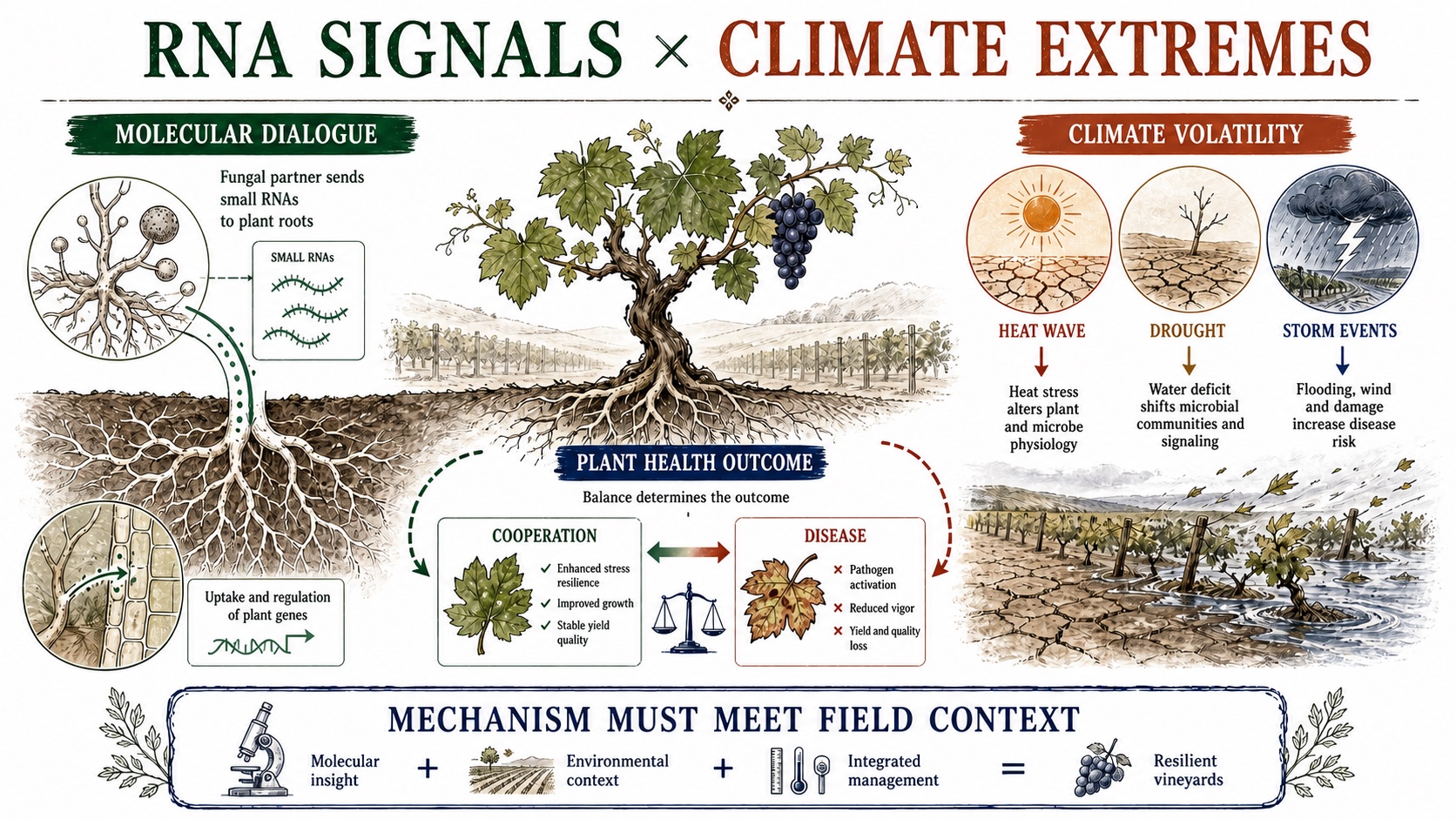
Plant health research is having a 'both/and' moment: we're learning more about the intimate molecular conversations between organisms, while also confronting how climate volatility can override or redirect those interactions in the field. Today's reading brought those two threads together, cross‑kingdom RNA effects that appear to promote arbuscular mycorrhiza development, and a broader synthesis on how climate extremes reshape pathogens, microbiomes, and plant health.
Why this matters
For anyone working at the interface of plant-pathogen interactions and crop resilience (including grapevine systems), the big challenge is translating mechanistic insight into outcomes that hold under real-world variability. Two points stand out:
-
Interactions are not just 'plant vs. pathogen.' Beneficial symbioses (like arbuscular mycorrhiza) and complex microbiomes can shift plant nutrition, stress tolerance, and potentially disease trajectories. If cross‑kingdom RNA interference (RNAi) can promote mycorrhiza development, it reinforces the idea that RNA-mediated signaling is not only a defense tool but also a coordination mechanism in plant-associated communities.
-
Climate extremes can rewire the rules. Heatwaves, droughts, intense rainfall, and rapid swings in conditions can change pathogen pressure, alter microbiome composition, and influence plant susceptibility. Even the best-targeted intervention, whether biological, chemical, or RNA-based, can perform differently when the environment pushes the system into a new regime.
For grapevine virology specifically, this is a reminder that disease management is increasingly a systems problem: viruses, vectors, host physiology, microbiomes, and weather extremes all interact. Mechanistic breakthroughs matter most when we can anticipate how they behave under stress.
What changed today
Two developments (as covered in the provided sources) sharpen the research field:
1) Cross‑kingdom RNAi framed as a promoter of arbuscular mycorrhiza development
The Nature-linked coverage highlights cross‑kingdom RNA interference as a mechanism that can promote arbuscular mycorrhiza development, not merely suppress antagonists. That framing is important: it suggests RNA exchange/signaling can be constructive, supporting symbiosis establishment or maintenance, rather than being limited to host defense or pathogen offense. The parallel news coverage reinforces the same theme from a science communication angle, indicating this is being treated as a notable shift in how we think about RNA traffic across organisms.
Practical implication: if RNA-mediated cross‑kingdom effects can tune symbiosis, then RNA-based tools (or strategies that use endogenous RNA exchange) might one day be used to steer plant-associated communities toward outcomes that improve plant performance, potentially including stress tolerance that indirectly affects disease.
2) Climate extremes positioned as a central driver of pathogen, microbiome, plant dynamics
The Nature-linked piece on climate extremes emphasizes that extremes influence plant pathogens, microbiomes, and plant health. The key 'change' here is not a single technique, but the consolidation of evidence that extremes are not just background noise, they can be primary determinants of which microbes thrive, how pathogens persist, and how plants respond.
Practical implication: management strategies need to be evaluated not only under average seasonal conditions but also under plausible extremes. This is especially relevant for perennial systems like grapevine, where multi-year carryover (in host tissues, vectors, and surrounding habitats) can amplify the effects of unusual seasons.
A connecting thread: where microbes persist between seasons
An additional lens comes from work on microbiomes and pathogen survival in crop residues, an ecotone between plant and soil. Even though this is not grapevine-specific, the concept is broadly useful: 'in-between' habitats can act as reservoirs or filters that shape next-season inoculum and microbiome assembly. When climate extremes alter decomposition rates, moisture regimes, or microbial competition in residues, they can indirectly influence disease risk and microbiome trajectories.
My research angle
My interests sit in grapevine virology, plant-pathogen interactions, and multi‑omics, with an eye toward interventions that are realistic to deploy (including formulation and, where appropriate, nanoencapsulation). These sources nudge me toward a few concrete research directions, framed as hypotheses and workflow ideas rather than conclusions.
1) Treat RNA-mediated cross‑kingdom effects as a 'community phenotype' to measure with multi‑omics
If cross‑kingdom RNAi can promote mycorrhiza development, I want to think of RNA exchange as something we can profile and relate to outcomes (colonization success, plant water status, stress markers). A multi‑omics approach could link:
- Small RNA / transcript signals (candidate cross‑kingdom RNA species or host response signatures),
- Microbiome composition (who is present),
- Plant physiological state (stress, growth, water status proxies).
Even without claiming direct causality from these sources alone, the conceptual shift is valuable: instead of measuring only 'pathogen load,' measure the interaction circuitry that might buffer plants against stress and disease.
2) Put climate extremes into the experimental design, not just the discussion
The climate-extremes synthesis pushes me to design experiments where extremes are first-class variables. For grapevine systems, that could mean:
- Comparing interaction outcomes under controlled drought/heat pulses vs. stable conditions,
- Tracking whether beneficial associations (e.g., mycorrhiza-related outcomes) remain stable under extremes,
- Testing whether disease-related phenotypes (symptoms, vector activity proxies, or plant vigor) correlate with shifts in microbial community structure.
The point is to avoid overfitting our conclusions to 'normal' seasons, especially as extremes become more frequent.
3) Don't ignore spatial scale and 'reservoir habitats'
Two sources help here: the crop-residue ecotone framing and the work on spatial scales affecting pathogen reproductive fitness. For vineyards, analogous reservoir habitats might include prunings, leaf litter, ground cover, and nearby vegetation. Spatial scale matters because:
- Microbial and pathogen processes operate from millimeters (biofilms, root interfaces) to meters (vine-to-vine spread) to field scales (vector movement, weather patterns).
- The 'best' intervention at one scale may fail at another.
A practical outcome for my own planning: when I interpret multi‑omics signals, I should annotate where the sample sits in the system (root zone vs. canopy; residue-adjacent vs. clean soil) and when (post-extreme event vs. baseline).
4) Where formulation thinking may enter later
While today's sources don't discuss nanoencapsulation directly, they strengthen the case for delivery strategies that can remain effective under environmental variability. If future RNA-based or microbiome-steering interventions are pursued, formulation constraints (stability under heat/UV, controlled release under moisture swings) will likely be decisive. I'm noting this as a downstream translational need rather than a claim supported by today's links.
References
- Cross-kingdom RNA interference promotes arbuscular mycorrhiza development - Nature Plants
- Impacts of climate extremes on plant pathogens, microbiomes and plant health - Nature Reviews Microbiology
- Microbiomes and pathogen survival in crop residues, an ecotone between plant and soil
- The effect of spatial scales on the reproductive fitness of plant pathogens