From Lipid Signaling to 3D Vines: New Clues for Smarter Plant Disease Research
Recent papers connect pathogen-driven immune manipulation, crop residue ecology, and high-resolution grapevine phenotyping. Together, they point toward a more integrated path for studying plant-pathogen interactions in perennial crops like grapevine.

Prem Pratap Singh
May 7, 2026 · 6 min read
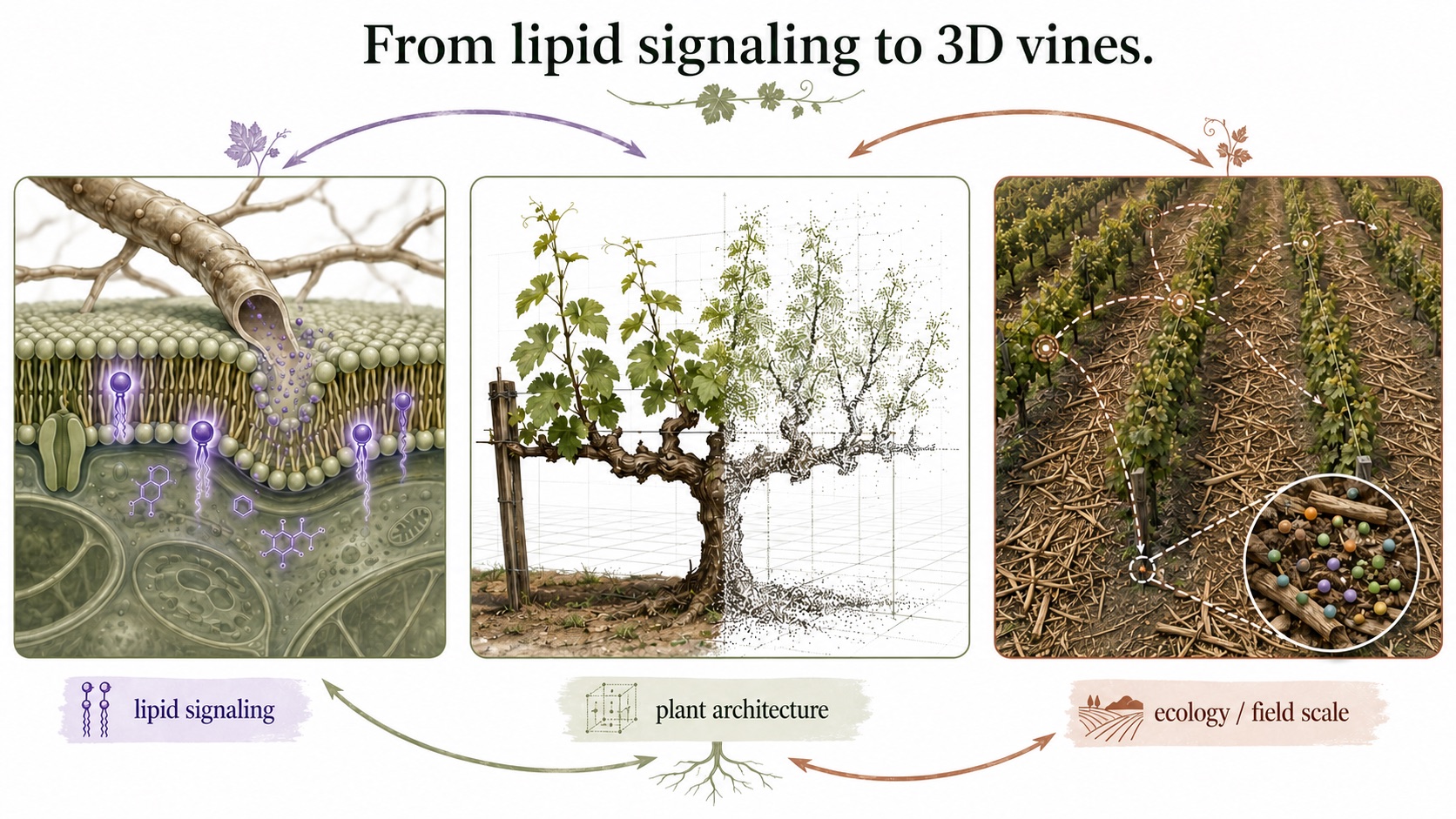
A few recent papers caught my attention because they sit at the intersection of mechanism, ecology, and measurement. One report points to a rice fungal pathogen altering host lipid signaling and immunity, while other studies focus on pathogen survival across spatial and residue-associated environments, and on better structural phenotyping in grapevine. Read together, they suggest a practical research direction: if we want better disease management, we need to connect molecular interaction data with plant architecture and field context.
Why this matters
Plant disease research often moves along separate tracks. One track studies how pathogens suppress or redirect host immunity. Another looks at how pathogens persist in the field, including in crop residues and across spatial scales. A third develops sensing and modeling tools to describe plant structure and stress. Each track is useful on its own, but disease outcomes in real crops emerge from all three at once.
For grapevine systems, this matters even more. Grapevines are perennial, structurally complex, and exposed to repeated biotic and abiotic pressures over many seasons. Even when a paper is not about grapevine directly, the concepts can still be relevant. A pathogen's ability to manipulate host signaling, the role of residues and surrounding microbiomes in inoculum survival, and the value of precise structural phenotyping all map onto questions that matter in viticulture.
The recent grapevine point-cloud work is a good example of where phenotyping is heading. Accurate 3D extraction of grapevine structure from high-resolution point clouds can improve how we quantify canopy architecture and woody framework. That has obvious value for pruning and crop management, but it also has research value for plant-pathogen studies. Architecture shapes microclimate, spray penetration, tissue exposure, and possibly the distribution of symptoms or vectors. Better structural data can make disease studies less approximate.
What changed today
The most immediate biological signal came from the report summarized by Bioengineer.org, which states that a rice fungus manipulates lipid signals and alters plant immunity. Based on the source provided, the key takeaway is not just that pathogens interfere with defense, but that lipid-associated signaling is part of that interference. For anyone working on plant-pathogen interactions, this is a reminder that immunity is not only about canonical defense genes. Metabolic and signaling lipids can be active parts of the conflict between host and pathogen.
At the ecological scale, the crop residue microbiome review adds another layer. Residues are described as an ecotone between plant and soil, a transition zone where microbiomes and pathogens interact in ways that affect survival and disease carryover. That framing is useful because it shifts attention from the living plant alone to the post-harvest environment that can shape the next infection cycle. In annual crops this is already a major issue, but the broader principle applies widely: pathogen persistence is embedded in community context.
A related theoretical contribution comes from the study on spatial scales and reproductive fitness of plant pathogens. Its focus on scale is important because pathogen success is not fixed, it depends on how host distribution and transmission opportunities are arranged in space. This is highly relevant when moving from controlled experiments to vineyards or orchards, where spacing, training system, and block design can influence disease spread.
On the phenotyping side, the new grapevine 3D structure extraction paper stands out because it addresses a bottleneck in perennial crop measurement. High-resolution point clouds can capture vine complexity, but extracting biologically meaningful structure is the hard part. Progress here can support better trait measurement for disease studies, especially when symptom expression or susceptibility may correlate with canopy density, shoot arrangement, or pruning architecture. The earlier work on automated pruning point detection through 2D plant modeling points in the same direction: computational plant modeling is becoming practical for grapevine management and research.
I also found it useful to revisit the older gene-expression biomarker study for plant water status. It is not a disease paper, but it reinforces a key idea for multi-omics work: stress states can be captured through molecular signatures across controlled and natural environments. In plant pathology, this matters because water status and disease responses are often entangled. If we can separate baseline abiotic stress from pathogen-induced responses, our interpretation of transcriptomic or metabolomic data becomes much stronger.
My research angle
What I take from these papers is a simple but important point: disease management will improve when we connect mechanism to context. In my own research interests, that means linking plant-pathogen interactions with multi-omics, structural phenotyping, and eventually intervention strategies such as nanoencapsulation.
The lipid-signaling result is a prompt to look beyond standard defense markers. In grapevine virology and other pathosystems, we often ask whether a host is resistant, susceptible, or stressed. That framing is too coarse. A better question is which signaling layers are being redirected, and whether those changes are visible across transcriptomic, metabolomic, and phenotypic levels. Multi-omics is useful here not because it is fashionable, but because pathogens rarely act through a single pathway.
The grapevine structure papers suggest another opportunity. If we can measure vine architecture accurately and repeatedly, we can start asking whether structural traits co-vary with disease pressure, symptom distribution, or treatment performance. This could be especially useful in long-lived crops where management history shapes plant form over time. Structural data may also help interpret why the same pathogen behaves differently across vineyards or training systems.
The residue microbiome and spatial-scale studies push the work outward, from the plant to the production system. For practical disease management, this is essential. A molecular mechanism discovered in one host-pathogen pair becomes more valuable when we understand where inoculum survives, how transmission is constrained by space, and how crop management changes those conditions. That systems view is also where nanoencapsulation could become relevant in the future, not as a stand-alone fix, but as one part of targeted delivery strategies informed by plant structure, pathogen biology, and timing of exposure.
So the common thread across today's reading is integration. We need molecular detail, but we also need architecture, ecology, and scale. For grapevine research in particular, that combination feels increasingly necessary.
References
- Rice false smut fungus hijacks rice lipid signalling to manipulate floret development and immunity - Nature Plants
- Accurate 3D Grapevine Structure Extraction from High-Resolution Point Clouds
- A biomarker based on gene expression indicates plant water status in controlled and natural environments
- Grapevine Winter Pruning Automation: On Potential Pruning Points Detection through 2D Plant Modeling using Grapevine Segmentation
- Microbiomes and pathogen survival in crop residues, an ecotone between plant and soil
- The effect of spatial scales on the reproductive fitness of plant pathogens