From Vine Structure to Pathogen Risk: What New Plant Sensing Papers Suggest for Grapevine Research
Recent papers on 3D grapevine reconstruction, pruning-point detection, plant water-status biomarkers, and pathogen ecology point toward a more connected way to study vine health. For grapevine research, the message is clear: structure, stress, and disease should be measured together, not in isolation.

Prem Pratap Singh
April 18, 2026 · 6 min read
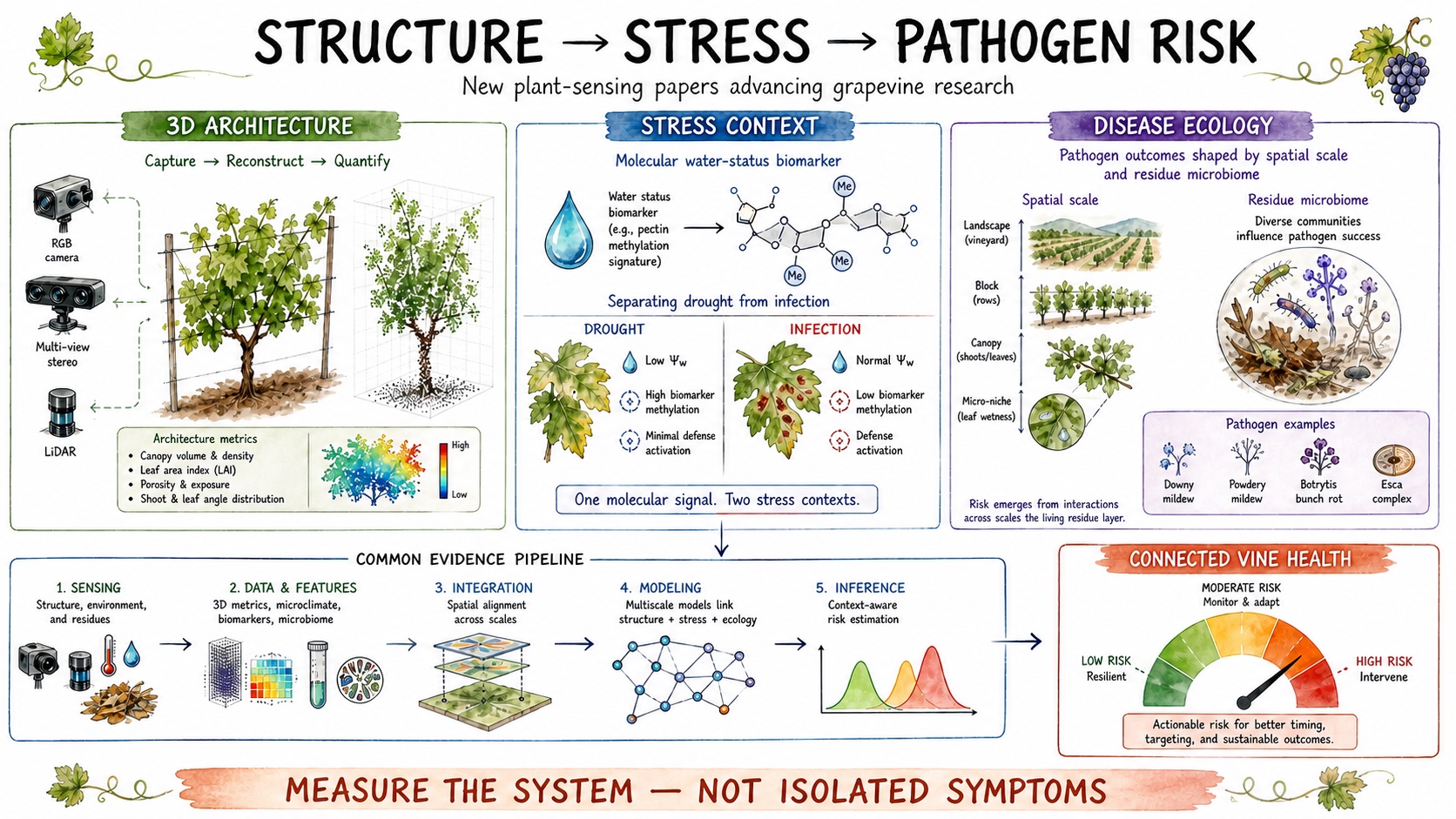
A few recent and relevant papers caught my attention because, taken together, they point to a practical shift in how we study grapevine health. Two focus on extracting vine structure from images and point clouds, one revisits molecular indicators of plant water status, and others frame pathogen success as a problem shaped by scale and by microbial life in crop residues. None of these papers is about grapevine viruses directly, but together they sharpen a research question I care about: how can we connect vine architecture, stress physiology, and pathogen pressure into one measurable system?
Why this matters
In grapevine systems, disease rarely acts alone. Virus symptoms can be confused with drought stress, canopy management changes vector movement and microclimate, and pruning decisions shape both productivity and exposure to infection. If we measure only one layer, such as symptoms, pathogen presence, or yield, we miss the interactions that actually drive field outcomes.
This is why I find the current mix of sensing, modeling, and plant-pathogen ecology so useful. High-resolution structural data can describe the vine as a physical system. Molecular biomarkers can report physiological state before severe visual symptoms appear. Ecological studies on pathogen spread and residue-associated microbiomes remind us that infection pressure is also spatial and environmental.
For grapevine virology and plant-pathogen work, this matters in a direct way. Better structural phenotyping could improve how we map symptom expression and management effects. Water-status biomarkers could help separate abiotic stress from disease-linked decline. Ecological context could explain why similar vines in the same block show different disease trajectories.
What changed today
The strongest signal from today's reading is not a single result, but a convergence.
The first paper, on 3D grapevine structure extraction from high-resolution point clouds, presents a route toward accurate digital reconstruction of grapevine architecture from sensing data. That matters because grapevine form is not just a breeding or engineering trait. It affects light interception, airflow, pruning choices, and the spatial pattern in which symptoms are observed. If structure can be extracted reliably, it becomes possible to align disease observations with actual vine geometry rather than with rough visual estimates alone.
A second grapevine-focused paper looks at winter pruning automation through detection of potential pruning points using 2D plant modeling and segmentation. The immediate application is automation, but the broader value is that pruning-relevant features can be identified computationally. For plant health research, this opens a path to quantify management structure at scale: cane distribution, node position, and pruning architecture could become analyzable variables in disease studies instead of handwritten notes.
A third paper, older but still useful, describes a gene-expression biomarker for plant water status across controlled and natural environments. I see this as a reminder that stress measurement can be made more objective and portable. In vineyards, where water status often interacts with disease expression, a molecular readout could help distinguish whether a vine is primarily under hydraulic stress, pathogen stress, or both. That distinction is often weak in field phenotyping.
Two ecology papers add an important frame. One examines how spatial scale affects reproductive fitness in plant pathogens. The key lesson is that pathogen success depends on the scale at which hosts and transmission opportunities are arranged. This is highly relevant to vineyards, where row structure, training system, and block design create repeated spatial patterns. The other paper reviews microbiomes and pathogen survival in crop residues, treating residues as an ecotone between plant and soil. For perennial systems, residues and pruning debris can be overlooked reservoirs or filters of microbial activity. Even when the focal pathogen is not residue-borne in a simple sense, the residue microbiome may shape inoculum survival and competition.
Taken together, these papers suggest a more integrated workflow: reconstruct vine structure, annotate management points such as pruning cuts, measure physiological stress with molecular markers, and interpret pathogen outcomes in a spatial ecological context.
My research angle
My own interest sits at the intersection of grapevine virology, plant-pathogen interactions, and multi-omics-informed management. What I take from these papers is a concrete hypothesis: disease expression in grapevine should be modeled as an interaction among architecture, stress state, and microbial or pathogen context.
For virus-associated decline, this could be especially useful. Viral infections often produce variable symptom severity across seasons and among neighboring vines. Some of that variation may reflect differences in vine structure and canopy density, which alter source-sink relations and local microclimate. Some may reflect water status, which changes host physiology and symptom visibility. Some may reflect the broader microbial setting around residues, roots, and wounds.
A practical research design follows from this. First, acquire structural phenotypes from 2D or 3D sensing, ideally at repeated time points. Second, pair these with targeted molecular measurements, such as stress-related expression markers and virological assays. Third, map the data spatially within the vineyard to test whether disease patterns align with architecture, management zones, or residue-associated risk. This is where multi-omics becomes useful, not as a buzzword, but as a way to connect host state, pathogen presence, and environmental context.
I also see a link to formulation and management work, including nanoencapsulation approaches for plant protection. If delivery systems are to be effective in perennial crops, they need to be matched to the actual structure and physiological state of the plant. A treatment strategy that ignores canopy architecture or stress status is likely to be inconsistent. Structural sensing could help define where interventions should be targeted, while molecular markers could indicate when the plant is most responsive.
There is also a food-system angle. Better disease and stress discrimination in vineyards has downstream value for fruit quality and safety. While the papers here do not address mycotoxins in grapes directly, the broader lesson from plant health management is familiar across crops: early, accurate detection improves both agronomic decisions and quality outcomes.
So the main change in my thinking today is this: I am less interested in studying grapevine disease as a single diagnostic event, and more interested in building a layered measurement framework. Structure tells us where the plant can respond. Biomarkers tell us how the plant is responding. Pathogen ecology tells us why pressure varies across space and time.
References
- Accurate 3D Grapevine Structure Extraction from High-Resolution Point Clouds
- Grapevine Winter Pruning Automation: On Potential Pruning Points Detection through 2D Plant Modeling using Grapevine Segmentation
- A biomarker based on gene expression indicates plant water status in controlled and natural environments
- The effect of spatial scales on the reproductive fitness of plant pathogens
- Microbiomes and pathogen survival in crop residues, an ecotone between plant and soil