From Single-Cell Four-Omics to Spatial Maps: The Multi-Omics Shift Plant Pathology Can't Ignore
Today's multi-omics news highlights how single-cell four-omics and spatial omics are rapidly maturing into practical toolkits, opening a clearer path to pinpoint where plant defenses and pathogen pressures actually play out inside tissues.

Prem Pratap Singh
April 2, 2026 · 6 min read
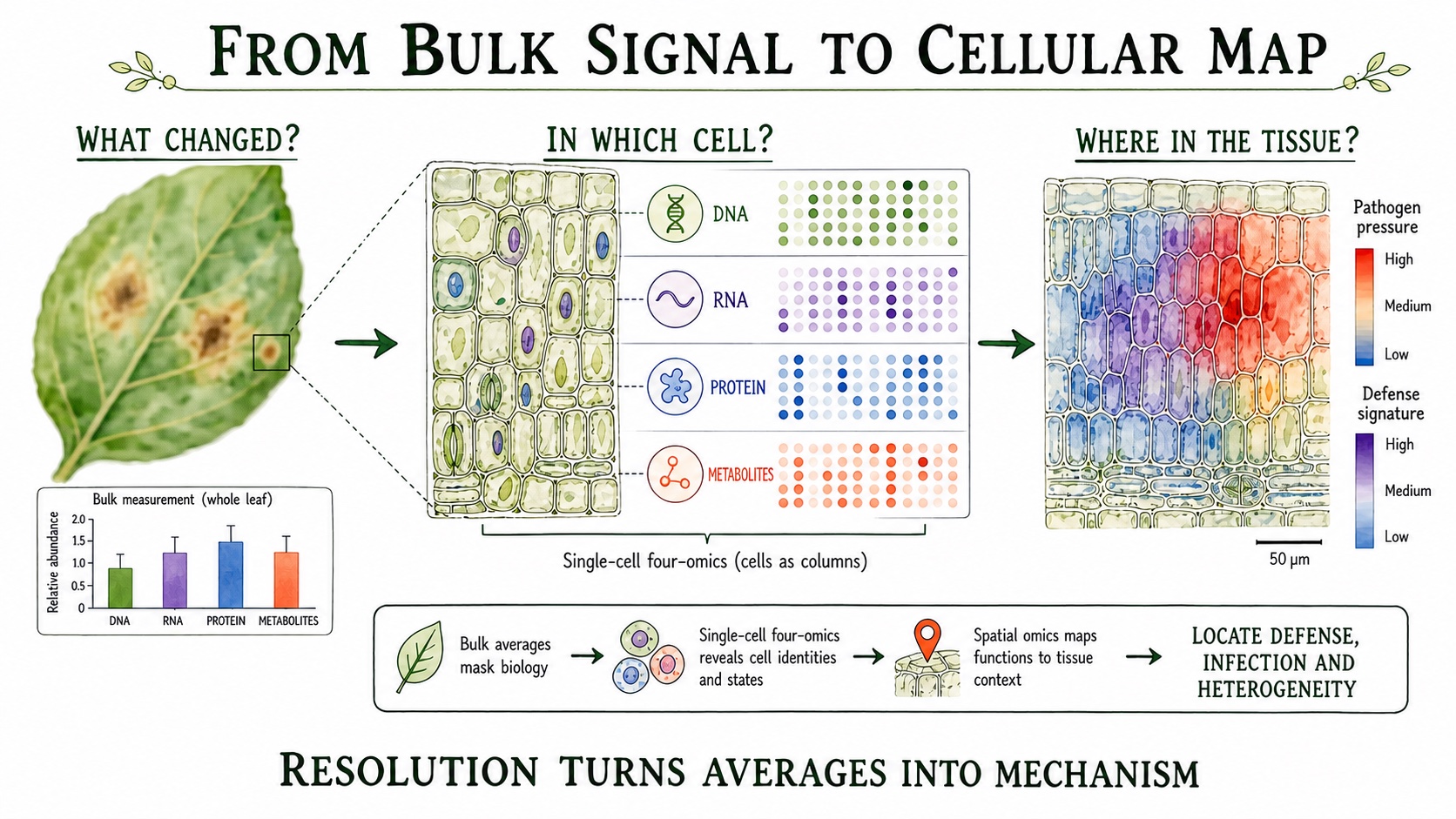
Plant-pathogen interactions are often described as molecular chess, but our measurements still too often look like a blurred snapshot taken after the match. Today's set of updates, spanning spatial omics, single-cell four-omics, and a mechanistic look at plant responses to bacteria linked with leaf waterlogging, reinforces a direction I've been watching closely: the field is moving from 'what changes' to 'where, in which cells, and in what regulatory context those changes occur.' For grapevine virology and disease management, that shift matters because symptoms and viral loads are notoriously heterogeneous across tissues, seasons, and even within a single leaf.
Why this matters
In plant health research (and especially in perennial crops like grapevine), we routinely face three bottlenecks:
-
Tissue complexity hides causality. Bulk assays average signals across cell types. If a defense program is activated in a small subset of cells, or if a pathogen manipulates a specific cell layer, bulk data can miss it or misattribute it.
-
Location is biology. Many disease phenotypes are spatial: vascular restriction, localized chlorosis, patchy necrosis, or compartmentalized metabolite accumulation. Spatial context is not a 'nice-to-have'; it's often the mechanism.
-
Management needs actionable targets. Whether the end goal is a formulation (including nanoencapsulation strategies), a diagnostic marker, or a breeding target, we need to know which pathways are truly upstream and which are downstream consequences.
The multi-omics trajectory highlighted today suggests we're getting closer to experiments that can separate host response from pathogen effect with higher resolution, by anchoring molecular readouts to cell identity and tissue position, and by integrating regulatory layers rather than treating them as separate stories.
What changed today
Three themes stand out from the sources.
1) Spatial omics is being framed as a practical frontier, not just a technical showcase. The Nature-linked piece on the 'potential of wheat spatial omics' signals growing momentum around mapping molecular features directly onto tissue architecture. Even though the example is wheat, the conceptual advance is broadly relevant: spatially resolved measurements can connect phenotype to microenvironments (e.g., vascular proximity, epidermal interfaces, lesion margins). For grapevine virology, that kind of mapping is a direct route to understanding why viral impacts can be stronger in particular tissues or developmental stages, and why sampling strategy can make or break downstream interpretation.
2) Single-cell 'four-omics' is pushing integration into the regulatory layer. The Nature-linked report on 'single-cell four-omics sequencing' emphasizes dissecting gene regulatory landscapes by measuring multiple molecular modalities in the same cells. The key implication for plant-pathogen work is not simply 'more data,' but better causal ordering: regulatory state, transcriptional output, and other layers can be aligned per cell rather than inferred across separate experiments. In practical terms, this can help distinguish:
- cells that are primed for defense vs. cells actively executing defense,
- pathogen-driven reprogramming vs. host-driven stress responses,
- and regulatory hubs that might be stable targets across environments.
3) Plant defense is being discussed in the context of specific bacterial interactions tied to leaf waterlogging. The Phys.org story on how plants fight bacteria that promote waterlogging in leaves underscores a mechanistic framing: microbes can influence leaf physiology in ways that create conditions favorable for themselves, and plants counteract those changes. Even without translating details directly to grapevine viruses, the conceptual bridge is important: pathogens (and associated microbes) can reshape the physical microenvironment, and the host response may be as much about restoring tissue function as it is about antimicrobial activity. This is exactly where spatial and single-cell approaches become decisive, because water status, apoplast conditions, and localized signaling are not uniform across a leaf.
A fourth link in the source list concerns rising cancer deaths (tagged with 'aflatoxin'). While it is not plant-pathogen mechanistic research, it is a reminder of the broader plant–food–health continuum: contamination and chronic exposure risks keep pressure on plant scientists to connect upstream agricultural biology with downstream health outcomes. For my own work, it reinforces why disease management and formulation strategies should be evaluated not only for yield and symptom reduction, but also for implications across the food system when relevant.
My research angle
My core interests sit at the intersection of grapevine virology, plant-pathogen interactions, and multi-omics, with an applied pull toward management and formulation (including nanoencapsulation where appropriate). Today's themes sharpen a few priorities I want to carry into upcoming planning and writing.
A) Designing grapevine virology studies that respect spatial heterogeneity Grapevine viruses and virus complexes often produce uneven symptom expression and uneven distribution. Spatial omics, conceptually validated in annual crops, offers a template for perennial systems: map host responses and (where feasible) pathogen signals across tissue regions rather than relying on a single composite sample. Even if we can't deploy full spatial transcriptomics in every project, the mindset changes sampling: lesion margins vs. healthy-looking tissue, vascular-adjacent regions vs. mesophyll-dominant regions, and time-resolved sampling across phenological stages.
B) Moving from 'differential expression' to 'regulatory state' Single-cell four-omics work points toward a future where we can ask: which regulatory programs define susceptible vs. resilient cell states? In grapevine, this could help disentangle:
- constitutive differences among cultivars/rootstocks,
- transient stress states driven by environment,
- and pathogen-induced reprogramming.
Even before full single-cell multi-omics becomes routine in woody tissues, we can adopt the logic: integrate layers (e.g., transcript + chromatin accessibility proxies, or transcript + metabolite readouts) in the same experimental design, and interpret results as regulatory trajectories rather than static lists.
C) Linking mechanistic insight to management (including formulations) Mechanistic plant defense stories, like the waterlogging-associated bacterial interaction, are useful because they suggest what to measure when evaluating interventions. If a management strategy (chemical, biological, or formulation-based) claims to reduce disease impact, multi-omics can test whether it:
- restores tissue function (water relations, vascular performance),
- shifts defense signaling to a less costly but effective mode,
- or inadvertently amplifies stress pathways.
This is where formulation science, including nanoencapsulation, can benefit from multi-omics: not as a marketing layer, but as a way to verify that delivery changes biology in the intended tissue and cell types.
D) Keeping the 'plant-food-health' thread visible Plant disease research sits in a continuum that includes crop performance, food quality, and public health. When we propose management strategies, we should be explicit about which outcomes are agronomic, which are quality-related, and which have potential health relevance.