From Plant Immunity to Grapevine Sensing: What Today's Papers Suggest About Smarter Disease Management
New reading today connected plant immunity, crop residue microbiomes, pathogen fitness across spatial scales, and high-resolution grapevine phenotyping. Together, they point toward a more predictive approach to grapevine disease management built on mechanism, structure, and context.

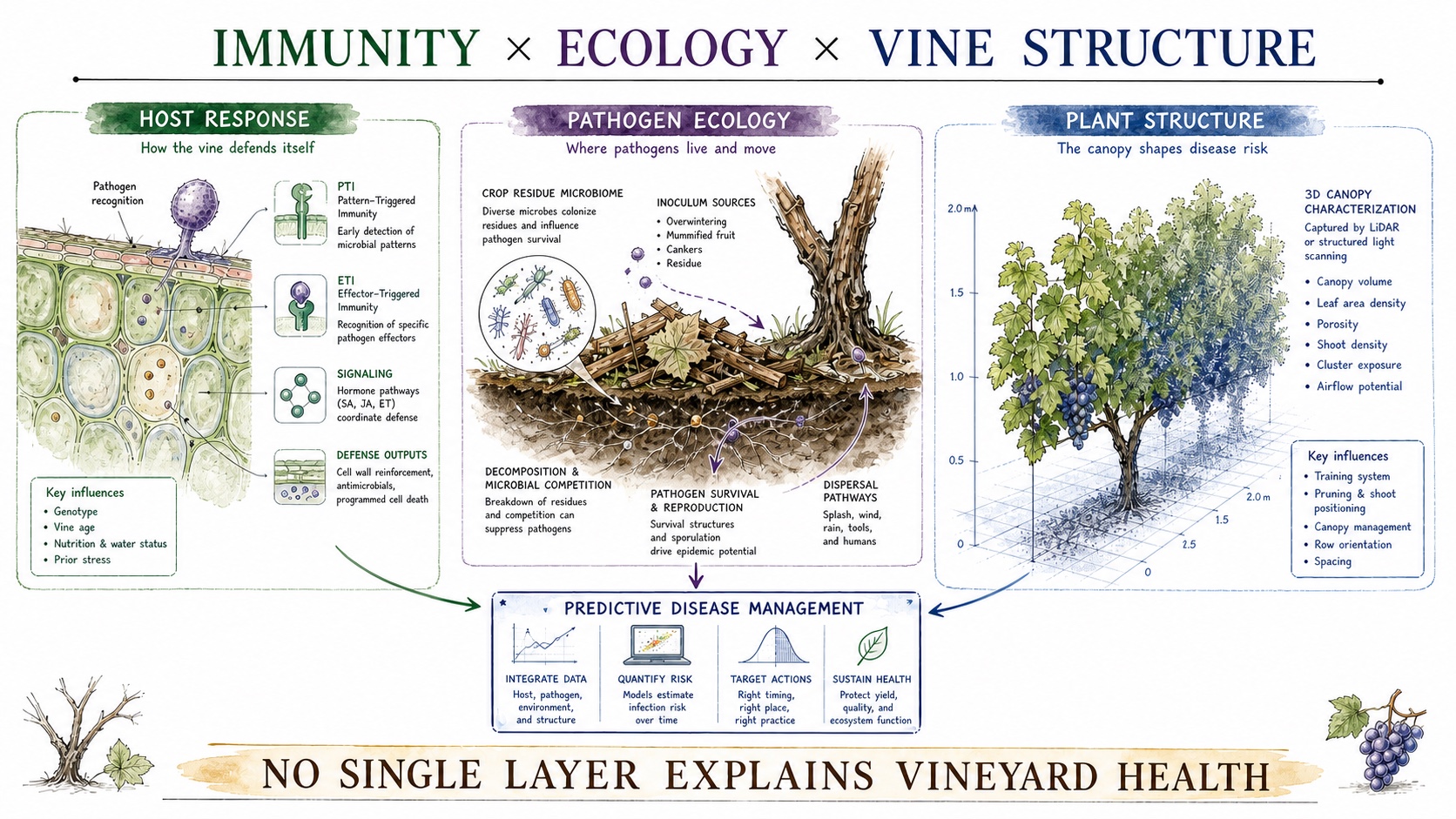
Today's reading did not deliver a single headline result for grapevine virology, but it did sharpen something I keep coming back to: disease management improves when we connect host response, pathogen ecology, and plant structure instead of treating them as separate problems. A set of papers on plant immunity, residue microbiomes, pathogen fitness, and grapevine imaging all push in that direction. For my own work, that is useful because grapevine virus systems are rarely explained by one layer alone.
Why this matters
In perennial crops such as grapevine, disease pressure builds over time and across scales. Viruses, fungal pathogens, vectors, pruning wounds, residue-associated inoculum, and water stress all interact with plant physiology and canopy structure. If we want better management, we need tools that explain not just whether a plant is diseased, but why symptoms emerge in one block, one season, or one vine architecture and not another.
The AgriLife summary on plant immunity highlights a basic but important point: plant defense is dynamic, and pathogens continue to evolve around it. That is not new in itself, but it remains central for any crop protection strategy that depends on stable resistance. In grapevine systems, where mixed infections and long-lived hosts are common, this matters even more. Durable management will likely come from combining host defense knowledge with ecological and structural data, not from relying on a single resistance mechanism.
The residue microbiome paper adds another layer. Crop residues act as an ecotone between plant and soil, shaping pathogen survival and microbial competition. Even though grapevine viruses are not residue-borne in the same way many fungal pathogens are, the broader lesson is relevant: pathogen persistence depends on community context. For vineyards, this has implications for trunk disease inoculum, pruning debris handling, and the microbial environment surrounding vines.
The spatial scale paper makes a similar point from a different angle. Pathogen reproductive fitness changes with spatial structure. That matters because vineyards are highly structured systems, row orientation, vine spacing, canopy density, and management zones can all alter transmission opportunities and host contact patterns. Scale is not just a statistical issue, it is part of disease biology.
What changed today
The most practical shift in my thinking came from pairing biological papers with two grapevine imaging and automation studies. The 3D grapevine structure extraction paper shows how high-resolution point clouds can recover detailed vine architecture. The pruning automation paper focuses on detecting potential pruning points through 2D plant modeling after segmentation. These are engineering papers, but they are relevant to pathology because architecture affects microclimate, wound distribution, and likely the spatial expression of stress and disease.
If we can measure vine structure accurately and repeatedly, we can start asking better pathology questions. Does a certain training architecture correlate with symptom distribution? Can structural complexity predict where pruning wounds accumulate and where infection risk is highest? Can imaging help separate virus-associated decline from water stress or canopy management effects?
The older arXiv paper on a gene-expression biomarker for plant water status also fits here. It reminds me that plant state can be measured at the molecular level in ways that may generalize across environments. In vineyards, symptom interpretation is often confounded by drought, heat, and uneven vigor. A molecular readout of water status, combined with structural phenotyping, could help disentangle abiotic stress from pathogen-driven effects.
The AgriLife article did not present a vineyard-specific breakthrough, but it framed the day's reading well: immunity research is moving toward mechanisms that can keep pace with evolving pathogens. What changed for me today is not a single conclusion, but a clearer sense that disease management should be built as an integrated sensing problem. We need to observe the plant's defense state, the pathogen's ecological setting, and the vine's physical form at the same time.
My research angle
My research interests sit at the intersection of grapevine virology, plant-pathogen interactions, and multi-omics, with growing attention to delivery systems such as nanoencapsulation. Today's papers reinforce the value of that combination.
First, multi-omics should not be treated as an end in itself. In grapevine virus research, transcriptomics, metabolomics, and small RNA data are most useful when they are tied to a defined biological question. The immunity and water-status papers both point toward interpretable host-state markers. That is the direction I find most promising: not just generating large datasets, but identifying signatures that distinguish infection, stress, compensation, and decline.
Second, structural phenotyping deserves a larger place in plant pathology. The grapevine point-cloud and pruning studies suggest that architecture can now be measured with enough detail to become a real variable in disease studies. For virology, this could support better symptom mapping and more precise sampling. For trunk and wound-associated diseases, it could directly inform management.
Third, ecological context remains underused in perennial crop pathology. The residue microbiome paper is a reminder that pathogens do not act alone. Even when the focal agent is a virus, the host is embedded in a microbial and environmental system. Mixed infections, endophytes, and management-driven shifts in the vineyard microbiome may all shape symptom severity and recovery.
Finally, this is where I see a future role for nanoencapsulation and targeted delivery. If we can define host-state biomarkers and map structural risk zones, then delivery strategies can become more precise. That could mean localized application near pruning wounds, timed delivery around stress periods, or formulations designed to stabilize bioactive compounds in field conditions. The papers I read today do not test nanoencapsulation directly, so I do not want to overstate that link. Still, they support the logic behind it: better measurement should lead to better intervention design.
For me, the key takeaway is simple. Better grapevine disease management will come from connecting mechanism with measurement. Immunity research explains part of the host response. Microbiome and spatial studies explain part of pathogen success. Imaging explains part of the plant's physical context. The next step is to bring these layers together in systems that are useful in real vineyards.
References
- Research advances plant immunity against evolving pathogens - Texas A&M AgriLife / EurekAlert
- Accurate 3D Grapevine Structure Extraction from High-Resolution Point Clouds
- A biomarker based on gene expression indicates plant water status in controlled and natural environments
- Grapevine Winter Pruning Automation: On Potential Pruning Points Detection through 2D Plant Modeling using Grapevine Segmentation
- Microbiomes and pathogen survival in crop residues, an ecotone between plant and soil
- The effect of spatial scales on the reproductive fitness of plant pathogens
From Vine Geometry to Disease Insight: Why 3D Grapevine Modeling Caught My Attention Today
NextFrom Lipid Signaling to 3D Vines: New Clues for Smarter Plant Disease Research
Related Articles
From Peach Defense Chemistry to Grapevine Sensing: What This Week Reveals About Smarter Plant Disease Management
6 min read
Single-Cell Mapping and New Mass Spectrometry Tools Point to a Sharper Future for Plant Multi-Omics
5 min read
From Point Clouds to Pathogens: What New Plant Research Suggests for Smarter Grapevine Disease Work
6 min read