From Vine Geometry to Disease Insight: Why 3D Grapevine Modeling Caught My Attention Today
Two recent preprints on grapevine structure and pruning automation point to a practical shift in how we can measure vine architecture at scale. For plant health research, that matters because better structural phenotyping can sharpen how we study stress, management, and host-pathogen interactions in vineyards.

Prem Pratap Singh
April 23, 2026 · 6 min read
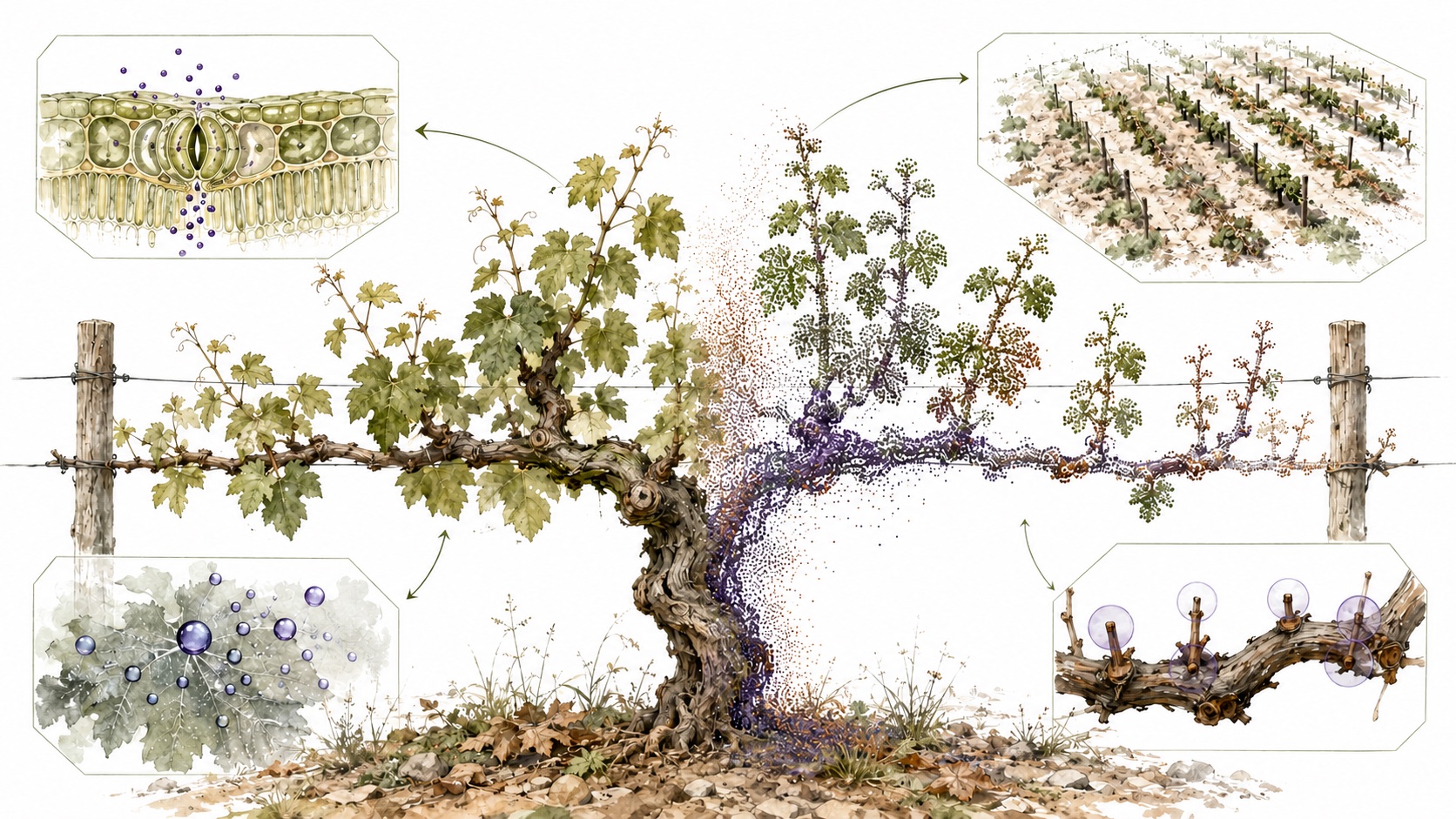
I have been thinking a lot about measurement lately, not only at the molecular level, but also at the scale of the whole plant. Today's reading pulled me toward a simple point: if we want better grapevine health research, we need better ways to describe the vine itself. Two arXiv papers on 3D structure extraction and pruning-point detection are not virology papers in the narrow sense, but they speak directly to a problem that sits underneath grapevine pathology, stress biology, and vineyard management: how to capture plant architecture accurately, consistently, and at scale.
Why this matters
In grapevine research, we often focus on pathogens, vectors, host responses, and management inputs. Those are central questions. Still, the physical structure of the vine shapes many of the conditions in which disease develops. Canopy density affects light, humidity, and airflow. Wood architecture influences pruning decisions and carryover growth. Structural variation also changes how imaging systems, sampling schemes, and field diagnostics perform.
That is why recent work on high-resolution plant reconstruction feels relevant beyond computer vision. A reliable 3D representation of a vine can become a bridge between field management and plant health research. If we can quantify branch structure, cane arrangement, and pruning-relevant geometry with less manual effort, we can ask better biological questions. We can compare stressed and healthy vines more rigorously, track structural effects of chronic infection, and connect architecture with water status or disease pressure.
This also fits with a broader trend in plant science. Gene-expression markers for water status showed, even years ago, that physiological state can be tracked across controlled and natural environments. At another scale, work on crop residue microbiomes reminds us that plant disease is shaped by ecological context, not just by the host and the pathogen in isolation. Structural phenotyping belongs in that same conversation. It gives us another layer of context, one that is often visible but poorly measured.
What changed today
The first paper that stood out was Accurate 3D Grapevine Structure Extraction from High-Resolution Point Clouds. From the title and framing alone, the contribution is clear: extracting grapevine structure from dense 3D data is becoming precise enough to support practical analysis, not just proof-of-concept visualization. For vineyard systems, that matters because point clouds can capture the woody framework in a way that 2D images often cannot.
The second paper, Grapevine Winter Pruning Automation: On Potential Pruning Points Detection through 2D Plant Modeling using Grapevine Segmentation, pushes the discussion toward action. Pruning is one of the most important management operations in viticulture, and it depends heavily on reading plant structure correctly. Automating potential pruning-point detection suggests that structural interpretation is moving from passive measurement to decision support.
Taken together, these papers suggest a shift: grapevine architecture is becoming machine-readable in ways that could support both management and research. That does not mean the biology is solved by imaging. It means we may soon have better structural data to pair with biological data.
For me, the key change is conceptual. I no longer see these papers as separate from plant-pathogen work. They are part of the same pipeline. If we can map vine structure accurately, then disease phenotyping can become more spatially explicit. We can ask whether infection correlates with specific architectural traits, whether pruning systems alter disease expression in measurable ways, and whether structural recovery after stress can be quantified over time.
There is also a practical lesson from the broader literature. Studies on pathogen fitness across spatial scales and on microbiomes in crop residues both point to the importance of spatial organization. Disease is not only about presence or absence. It is about where things are, how they persist, and how they interact across scales. Structural models of the vine could help bring that spatial thinking into vineyard pathology more directly.
My research angle
My own interest sits at the intersection of grapevine virology, plant-pathogen interactions, and multi-omics. What I take from today's papers is not that imaging replaces molecular work, but that it can make molecular work more meaningful.
In grapevine virus research, one recurring challenge is linking molecular detection to plant performance. We can detect viruses, profile transcripts, and measure metabolites, but the translation from those signals to field-level symptoms is often messy. Symptom expression varies with cultivar, environment, season, and management. Structural phenotyping could help reduce some of that ambiguity.
A useful future design, at least in principle, would combine four layers: pathogen status, host molecular response, water or stress indicators, and vine architecture. The gene-expression biomarker paper on plant water status is a good reminder that physiological state can be measured in transferable ways. If that kind of readout is paired with 3D vine structure, we might be able to separate direct pathogen effects from stress-related architectural changes. That would be valuable in perennial systems where symptoms accumulate slowly and are shaped by management history.
I also see a connection to nanoencapsulation and targeted delivery, which remains one of my longer-term interests in plant health management. Delivery systems are often discussed at the biochemical level, but delivery in the field is constrained by plant form. Canopy structure, bark exposure, pruning wounds, and shoot arrangement all affect where treatments land and how they move. Better structural maps could eventually inform more precise application strategies, whether the intervention is nutritional, microbial, or nanoparticle-based.
There is a second angle that feels just as important: residue and carryover ecology. The crop residue microbiome paper frames residues as an ecotone between plant and soil. In vineyards, retained wood, prunings, and canopy debris are not neutral background. They are part of the disease environment. If structural imaging and pruning automation improve, they may also help us study how management reshapes that environment over time.
So the main takeaway from today is modest but important. Better grapevine structure extraction is not just a technical convenience. It could become a common reference layer across management, physiology, and pathology. For a field like grapevine health, where chronic stress and long-lived architecture are tightly linked, that is a useful direction.
References
- Accurate 3D Grapevine Structure Extraction from High-Resolution Point Clouds
- Grapevine Winter Pruning Automation: On Potential Pruning Points Detection through 2D Plant Modeling using Grapevine Segmentation
- A biomarker based on gene expression indicates plant water status in controlled and natural environments
- Microbiomes and pathogen survival in crop residues, an ecotone between plant and soil
- The effect of spatial scales on the reproductive fitness of plant pathogens
- Speciation due to hybrid necrosis in plant-pathogen models