From Crop Residues to Cross-Omics: A Practical Path to Predicting Plant Disease Before Symptoms
Today's thread connects two often-separated worlds, how pathogens persist in crop residues and how modern cross-omics integration can turn messy, incomplete datasets into earlier, more actionable disease signals. The takeaway: pairing residue ecology with multi-omics modeling is a realistic route to better forecasting and management decisions.

Prem Pratap Singh
March 19, 2026 · 6 min read
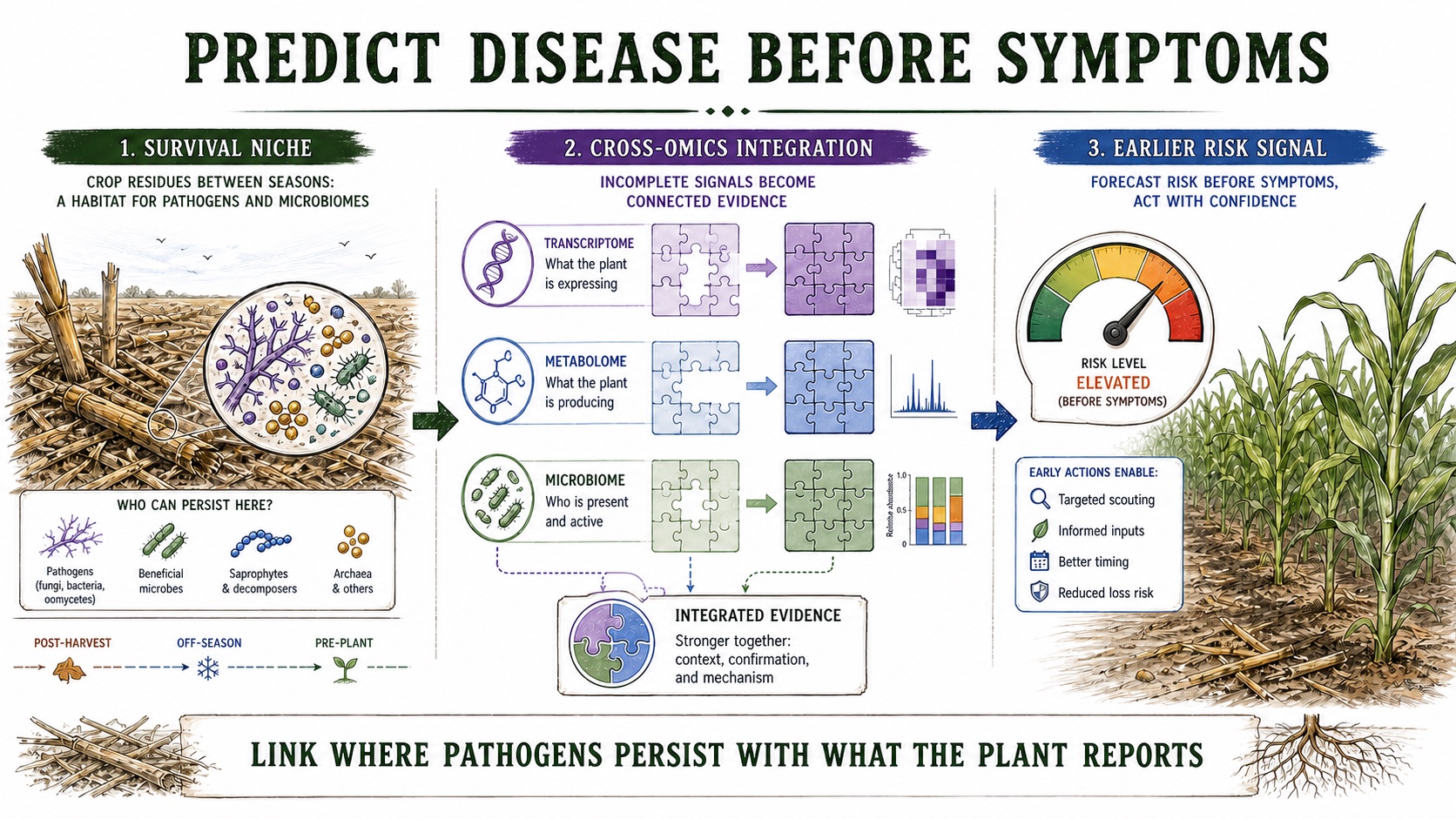
Plant disease management still too often begins when symptoms are already visible, by then, the pathogen has had time to spread, and interventions become more expensive and less effective. What I've been thinking about today is a more upstream view: disease risk is shaped not only by what happens inside the plant, but also by what happens around it, especially in the 'in-between' habitats where pathogens persist. At the same time, multi-omics and machine learning are getting better at extracting signal from incomplete, real-world datasets. Putting these together suggests a practical research direction: predict risk earlier by linking pathogen survival niches with integrated omics readouts.
Why this matters
In grapevine virology and broader plant-pathogen interactions, the hardest problems are rarely about detecting a pathogen in a lab. They're about timing and context: when is infection pressure rising, where is inoculum coming from, and which blocks are most vulnerable given plant status and environment.
Two ideas are especially relevant:
-
The disease cycle doesn't start at the leaf. Many pathogens survive outside the living plant, on residues, in soil-adjacent microhabitats, or on alternative hosts. These zones act as reservoirs that can re-seed infection when conditions turn favorable. If we only sample symptomatic tissue, we miss the earlier ecological stages that determine outbreak probability.
-
We now generate more data than we can reliably integrate. In practice, field studies produce incomplete multi-omics: missing timepoints, uneven sampling across blocks, and partial assays (e.g., transcriptomics for some samples, metabolomics for others). Traditional integration methods often assume neat, matched datasets. That assumption fails in agricultural reality.
For grapevine systems, this matters because management decisions (canopy operations, irrigation scheduling, vector control, sanitation, and, where relevant, formulation choices such as nanoencapsulation approaches for delivery) benefit from risk forecasts, not just diagnostics. A forecast needs both ecology (inoculum and survival) and host status (physiology and defense readiness).
What changed today
Two strands of recent reading sharpened my thinking.
First: crop residues as an 'ecotone' that shapes pathogen survival. The arXiv preprint on microbiomes and pathogen survival in crop residues frames residues as a transition zone between plant and soil, an ecological interface where microbial communities can either suppress or help pathogen persistence. The key value of this framing is that it treats residues not as inert waste but as a dynamic habitat with community interactions that influence whether a pathogen successfully bridges seasons or management events. That's directly relevant to any system where sanitation, residue handling, or groundcover management affects disease pressure, even if the specific pathogens differ across crops. It also provides a conceptual bridge to vineyard floor management: what persists, where, and under which microbial competitive regimes.
Second: cross-omics integration that tolerates incompleteness. The CLCLSA preprint proposes a contrastive learning + self-attention approach for integrating multi-omics data when parts of the omics matrix are missing. Even without adopting a specific model wholesale, the direction is important: it acknowledges the reality of incomplete datasets and tries to learn strong linked representations across omics layers. For plant disease work, that's a big deal because 'perfectly paired' omics is the exception, not the norm, especially across seasons, sites, and international collaborations.
A third piece that complements these is the arXiv work on a gene-expression biomarker for plant water status across controlled and natural environments. Water status is a major confounder in plant-pathogen studies because drought or over-irrigation can shift defense signaling, canopy microclimate, and vector behavior. If water status can be inferred from expression biomarkers across environments, it becomes easier to separate 'stress physiology' from 'pathogen response' in field omics, improving interpretability of disease-associated signals.
Finally, I revisited a modeling perspective on spatial scale and pathogen reproductive fitness. Spatial scale determines contact structure: how inoculum disperses, how host density and arrangement shape transmission, and how local management scales up (or fails to) at the block or field level. For vineyard disease management, scale is not academic, it's the difference between a within-row intervention and an area-wide strategy.
My research angle
My own interests sit at the intersection of grapevine virology, plant-pathogen interactions, and multi-omics, always with an eye toward management and formulation. Here's the angle that feels most actionable after today's reading:
1) Treat 'outside-the-plant' habitats as first-class data sources
If residues and soil-adjacent interfaces are active arenas for pathogen persistence, then sampling strategies should reflect that. In vineyards and other perennial systems, the analogous habitats might include prunings, leaf litter, bark surfaces, and groundcover zones, places where microbial antagonists and pathogens interact. The residue-ecotone concept suggests designing studies that measure not just pathogen presence, but community context (who else is there) and functional potential (what metabolic capacities are enriched).
2) Build multi-omics models that expect missingness
Instead of discarding incomplete samples, we should design integration pipelines that can learn from partial omics. This is where cross-omics representation learning becomes attractive: it can, in principle, map transcript, metabolite, and microbiome features into a shared space even when one layer is absent for a subset of samples. For grapevine virology, this could help connect:
- host transcriptional defense signatures,
- metabolite shifts linked to stress or infection,
- microbiome patterns in residues or phyllosphere,
- and environmental covariates.
The practical payoff is earlier warning signals, patterns that emerge before clear symptoms or before virus titers peak.
3) Control for water status to avoid false disease signals
The water-status biomarker work is a reminder that plant physiology can masquerade as disease response in omics. In vineyards, irrigation differences across blocks can generate strong expression and metabolite shifts. If we can estimate water status (or at least include strong proxies), we can reduce confounding and improve the specificity of disease-associated features. That's essential if the end goal is decision support rather than post hoc explanation.
4) Keep spatial scale explicit from day one
Disease risk is spatial. Even the best omics signature won't translate into management if it ignores dispersal and block structure. The spatial-scale perspective encourages designing sampling grids and models that align with how decisions are made: vine, row, block, and region. For international work, it also helps reconcile why the same pathogen behaves differently across climates and management regimes.
5) Where nanoencapsulation fits (carefully)
I'm interested in nanoencapsulation as a formulation strategy, but the key is to connect it to a validated risk model rather than treating it as a standalone 'tech fix.' If multi-omics + ecology can identify when and where intervention is most valuable, then advanced formulations can be evaluated in a targeted way (right timing, right microhabitat, right delivery constraints). That sequencing, forecast first, formulation second, keeps the work grounded in management reality.
References
- Microbiomes and pathogen survival in crop residues, an ecotone between plant and soil
- CLCLSA: Cross-omics Linked embedding with Contrastive Learning and Self Attention for multi-omics integration with incomplete multi-omics data
- A biomarker based on gene expression indicates plant water status in controlled and natural environments
- The effect of spatial scales on the reproductive fitness of plant pathogens