From Vine Geometry to Disease Defense: What Today's Plant Papers Suggest for Smarter Grapevine Health Research
New papers and funding news point to a useful convergence: better plant structure sensing, stress biomarkers, and pathogen ecology are starting to connect with practical disease management. For grapevine research, that opens a clearer path toward multi-scale, data-driven virology and crop protection.

Prem Pratap Singh
May 14, 2026 · 6 min read
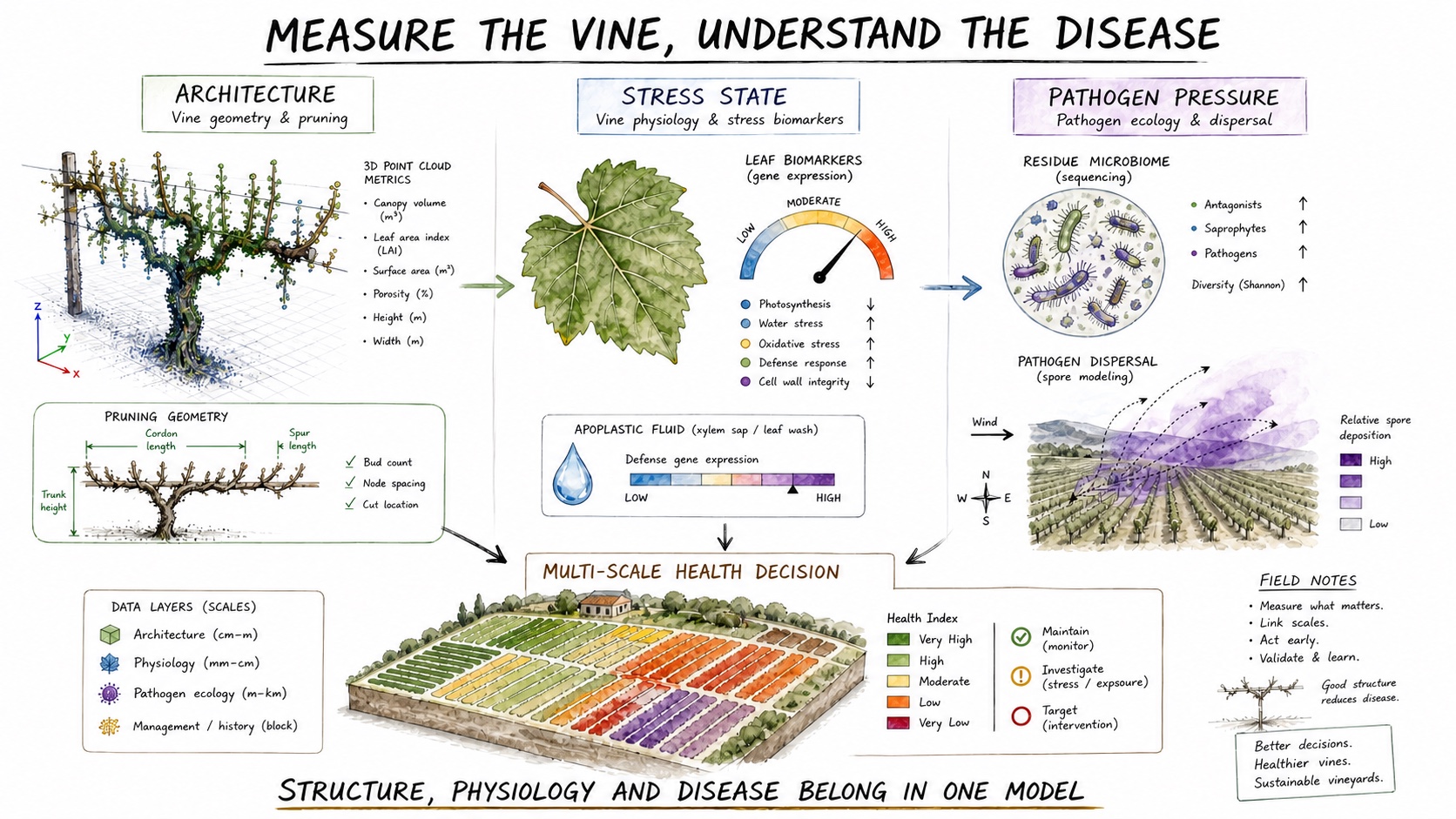
A good research day is not always about a single major result. Sometimes the signal comes from several smaller developments that line up in a useful way. Today's set of sources does that well. They span grapevine structure extraction, pruning automation, plant water-status biomarkers, pathogen survival in crop residues, and the spatial ecology of plant disease, with a startup story in the background that points to growing commercial interest in crop defense. Taken together, they suggest a practical direction for grapevine health research: connect plant architecture, stress state, and pathogen pressure in one framework.
Why this matters
In grapevine systems, disease rarely acts in isolation. Viral infection, water stress, canopy structure, pruning decisions, and surrounding inoculum sources can all shape symptom expression and long-term decline. If we want better management, we need measurements that are both biologically meaningful and operationally feasible.
Two of today's grapevine-focused papers are not about virology directly, but they still matter. High-resolution 3D structure extraction from point clouds and 2D modeling for pruning-point detection both address a basic problem: how to describe the vine accurately and at scale. That matters because architecture influences microclimate, vigor, and management interventions. In perennial crops like grapevine, those factors can affect how disease develops over multiple seasons.
The plant water-status biomarker paper adds another layer. Water stress can change host physiology and can complicate disease interpretation in the field. A molecular indicator of plant water status offers a way to separate stress effects from pathogen effects, at least in principle. For anyone working on grapevine virology or plant-pathogen interactions, that is useful because symptom severity is often not explained by infection status alone.
The ecology papers also matter for management. Pathogen survival in crop residues highlights the residue zone as an active interface between plant and soil microbiomes. The spatial-scale paper reminds us that pathogen fitness depends on how hosts are arranged and connected. In vineyards, where row structure, pruning, sanitation, and surrounding vegetation all shape exposure, this kind of thinking is directly relevant.
What changed today
The clearest update is not one discovery, but a stronger sense that plant health research is becoming more integrative.
On the phenotyping side, the new arXiv paper on 3D grapevine structure extraction shows continued progress in reconstructing detailed vine architecture from high-resolution point clouds. That kind of structural data can support more precise monitoring of growth, pruning outcomes, and canopy traits. The earlier pruning automation paper fits the same trend, showing how segmentation and 2D plant modeling can identify potential pruning points. These are engineering papers, but they point toward a future where vine structure is not scored loosely by eye, but measured consistently.
On the physiology side, the gene-expression biomarker study remains relevant because it proposes a molecular readout of plant water status that works across controlled and natural environments. The key value here is transferability. If a biomarker can hold up outside tightly controlled conditions, it becomes much more useful for field research.
On the disease ecology side, the crop-residue microbiome paper frames residues as an ecotone, not just waste material. That is a helpful concept. It shifts attention toward survival niches, microbial competition, and carryover between seasons. The spatial-fitness paper adds a population perspective, showing that pathogen reproductive success changes with spatial scale. For vineyard disease management, this supports the idea that block design, sanitation zones, and local host density can influence outcomes.
The startup news around Resurrect Bio is also worth watching, with the usual caution that company announcements are not peer-reviewed evidence. Still, the funding signal matters. Investors are backing approaches aimed at helping plants defend themselves against disease. That does not validate any specific method on its own, but it does show that crop disease resistance remains an active translational area.
My research angle
What I take from these sources is a fairly simple research agenda: grapevine disease work should connect structure, stress, and pathogen biology more tightly.
For grapevine virology, one persistent challenge is that infection status does not map neatly onto visible decline. Some vines remain productive with infection, while others show strong symptoms or reduced vigor. Part of that variation may come from host genotype and virus strain, but part may also come from architecture and stress context. A vine with different pruning history, canopy density, or water status may not respond the same way to the same pathogen load.
This is where multi-omics and phenotyping can meet in a useful way. Structural phenotyping, whether from point clouds or image-based modeling, can quantify the physical state of the vine. Molecular markers can report on stress physiology. Pathogen assays can define infection and titer. If these layers are collected together, we can ask better questions: when does stress amplify disease expression, when does architecture buffer it, and which management actions shift the system toward resilience?
I also see a link to practical disease management. Precision pruning and structural mapping could eventually support cleaner intervention strategies, especially in systems where wood health and long-term vine form matter. Residue ecology and spatial pathogen fitness suggest that disease control should not stop at the individual plant. The relevant unit may be the row, the block, or the residue zone between seasons.
There is also room here for nanoencapsulation and targeted delivery research, which remains one of my broader interests. None of today's papers directly test nanoencapsulated antiviral or antimicrobial strategies in grapevine. Still, the logic is clear: if we can map vine structure better and classify stress state more reliably, then targeted delivery systems can be designed and evaluated in a more informed way. Delivery is only as good as the biological context in which it is deployed.
So the main takeaway for me is not that one paper changes the field overnight. It is that the pieces are becoming easier to connect. Better geometry, better stress readouts, and better ecological framing can support a more precise approach to grapevine health. That is the kind of integration I want to see more often in plant-pathogen research.
References
- Accurate 3D Grapevine Structure Extraction from High-Resolution Point Clouds
- Grapevine Winter Pruning Automation: On Potential Pruning Points Detection through 2D Plant Modeling using Grapevine Segmentation
- A biomarker based on gene expression indicates plant water status in controlled and natural environments
- Microbiomes and pathogen survival in crop residues, an ecotone between plant and soil
- The effect of spatial scales on the reproductive fitness of plant pathogens
- Resurrect Bio closes €8.8 million Series A to develop disease-resistant crops - EU-Startups
- Resurrect Bio expands Series A to scale plant-immunity technology - AgFunderNews