Cross‑Kingdom RNAs: The Plant Pathogen Trick We’re Only Just Catching
New reporting on a pathogen lncRNA that sequesters a rice miRNA adds another clear example of RNA-based virulence. For plant-pathogen research, this sharpens the case for pairing molecular biology with multi-omics to track how small RNAs and long non-coding RNAs shape infection.

Prem Pratap Singh
May 21, 2026 · 5 min read
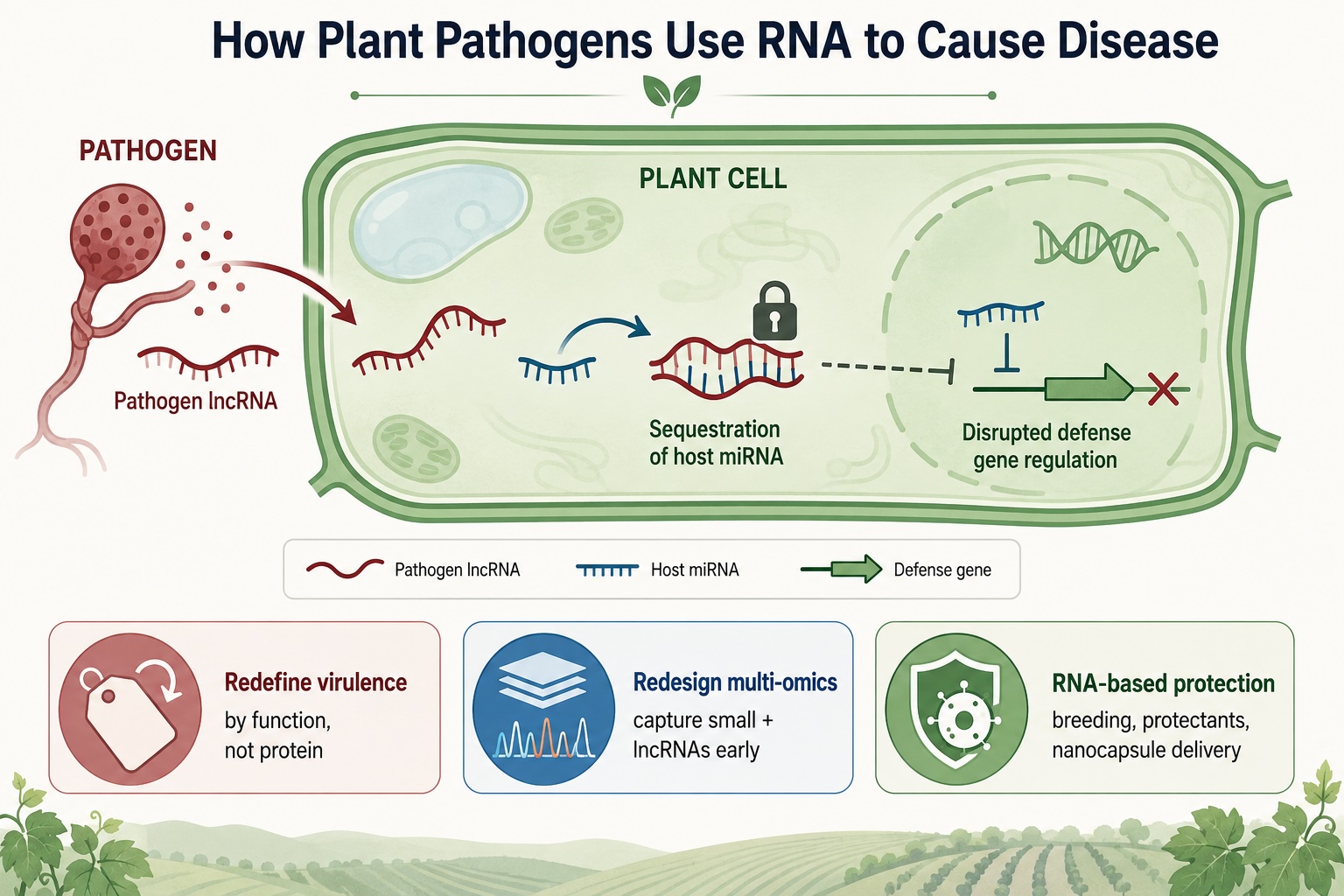
A seemingly small update in plant-pathogen biology can sometimes change how we think about disease control. Today's report on a pathogen long non-coding RNA (lncRNA), secreted into rice, where it sequesters a host miRNA, is one of those cases. The core idea is simple: pathogens are not just delivering proteins and metabolites into host cells; they can also deploy regulatory RNAs that interfere with host gene control. That matters well beyond rice, because it strengthens the growing evidence that cross-kingdom RNA exchange is part of the infection toolkit.
Why this matters
For anyone working in grapevine virology and plant-pathogen interactions, the main lesson here is not limited to a single pathosystem. It is conceptual. We usually frame virulence in terms of effectors, toxins, and host immune receptors. Those remain central, but RNA-mediated interference is becoming harder to treat as a side story.
A pathogen-secreted lncRNA that binds and sequesters a host miRNA suggests a direct route for rewiring host responses. Rather than tweaking one protein target at a time, the pathogen can hit a regulatory node that controls multiple downstream genes. That can create broad effects on defense, metabolism, and symptom development.
This is also a reminder that non-coding RNAs deserve more attention in crop disease research. In perennial systems such as grapevine, where mixed infections, long latent periods, and environmental stress often overlap, regulatory RNAs may help explain variation that is hard to capture with standard pathogen detection alone. If host small RNAs and pathogen non-coding RNAs are interacting during infection, then transcript abundance by itself may miss the real control points.
From a management perspective, this kind of finding points toward new intervention strategies. If virulence depends on a specific RNA-RNA interaction, then blocking that interaction becomes a plausible target. That could mean breeding for altered host RNA motifs, designing RNA-based protectants, or exploring delivery systems, such as nanoencapsulation, for more stable field applications. The path from mechanism to product is long, but the mechanism matters because it tells us what is worth trying.
What changed today
The key report is that a pathogen lncRNA is secreted into rice and sequesters a host miRNA for virulence. Based on the source coverage, the finding supports a model in which the pathogen exports a non-coding RNA into the host, and that RNA acts as a molecular decoy or sponge. By tying up the host miRNA, the pathogen weakens normal host regulation in a way that benefits infection.
Even in summary form, this is a meaningful step. Plant pathology has already seen strong examples of small RNA exchange across kingdoms, but lncRNAs have been less visible in day-to-day discussion. This report pushes lncRNAs closer to the center of the conversation. It also reinforces the idea that virulence factors should be defined by function, not by whether they encode proteins.
The broader context from the available sources is useful. One article frames the finding directly around virulence in rice, while another popular summary emphasizes the hijacking of host miRNA machinery. Taken together, they point to the same conclusion: pathogen success can depend on manipulating host post-transcriptional regulation.
I also noticed a practical contrast in today's source list. Alongside this molecular result, there is a piece on sustainable pest management education and another on climate-linked conservation risk in an Andean plant. These are very different stories, but they sit on the same continuum. Better molecular understanding improves management options, and management decisions happen under ecological constraints that are getting tighter with climate pressure. Plant health research works best when those scales stay connected.
My research angle
My own interest is in grapevine virology, plant-pathogen interactions, and multi-omics, so I read this result as a prompt to widen the search space. In grapevine disease research, we already think about viral suppressors of RNA silencing, host small RNA responses, and the complexity of mixed infections. What this rice study adds is a stronger reason to ask whether non-coding RNAs from pathogens, including viruses and associated microbes, are acting as direct regulatory agents in host tissues.
That has a few practical implications.
First, multi-omics designs should be built to capture non-coding RNA biology from the start. If sampling only supports standard mRNA sequencing, we may miss the most informative layer. Small RNA sequencing, long-read transcriptomics where possible, and careful host-pathogen assignment of reads become more important when RNA-RNA interactions are part of the hypothesis.
Second, infection studies should pay closer attention to timing. Regulatory interference may occur early, before visible symptoms or large shifts in bulk transcript levels. In perennial crops, that timing issue is especially important because symptom expression can be delayed, seasonal, and uneven across tissues.
Third, delivery science deserves a place in the same conversation. If RNA-mediated virulence is real and specific, then RNA-mediated protection is not a speculative add-on. This is where nanoencapsulation becomes relevant to my broader interests. Stable delivery of RNA molecules, or of compounds that disrupt harmful RNA interactions, could serve as a useful bridge between mechanistic discovery and field management. That does not mean every elegant molecular finding will translate into a product. It does mean we should design discovery work with delivery constraints in mind.
Finally, this kind of result argues for a more integrated view of plant disease management. Molecular mechanisms, crop protection, and field practice are often discussed separately. They should not be. Good research questions should acknowledge both the molecule and the production system in which it operates.
For me, the takeaway is clear: non-coding RNAs are moving from interesting detail to central mechanism in plant-pathogen biology. If that trend holds across more pathosystems, then future disease research in grapevine and other crops will need to treat RNA trafficking, RNA sequestration, and host regulatory disruption as standard parts of the virulence model.