Measuring Vines in 3D and Modeling Pathogens Across Scales: Closing the Loop
How 3D vine structure extraction and pruning-point detection are becoming instruments for biology, and why scale-aware pathogen modeling changes management decisions.

Prem Pratap Singh
March 2, 2026 · 6 min read
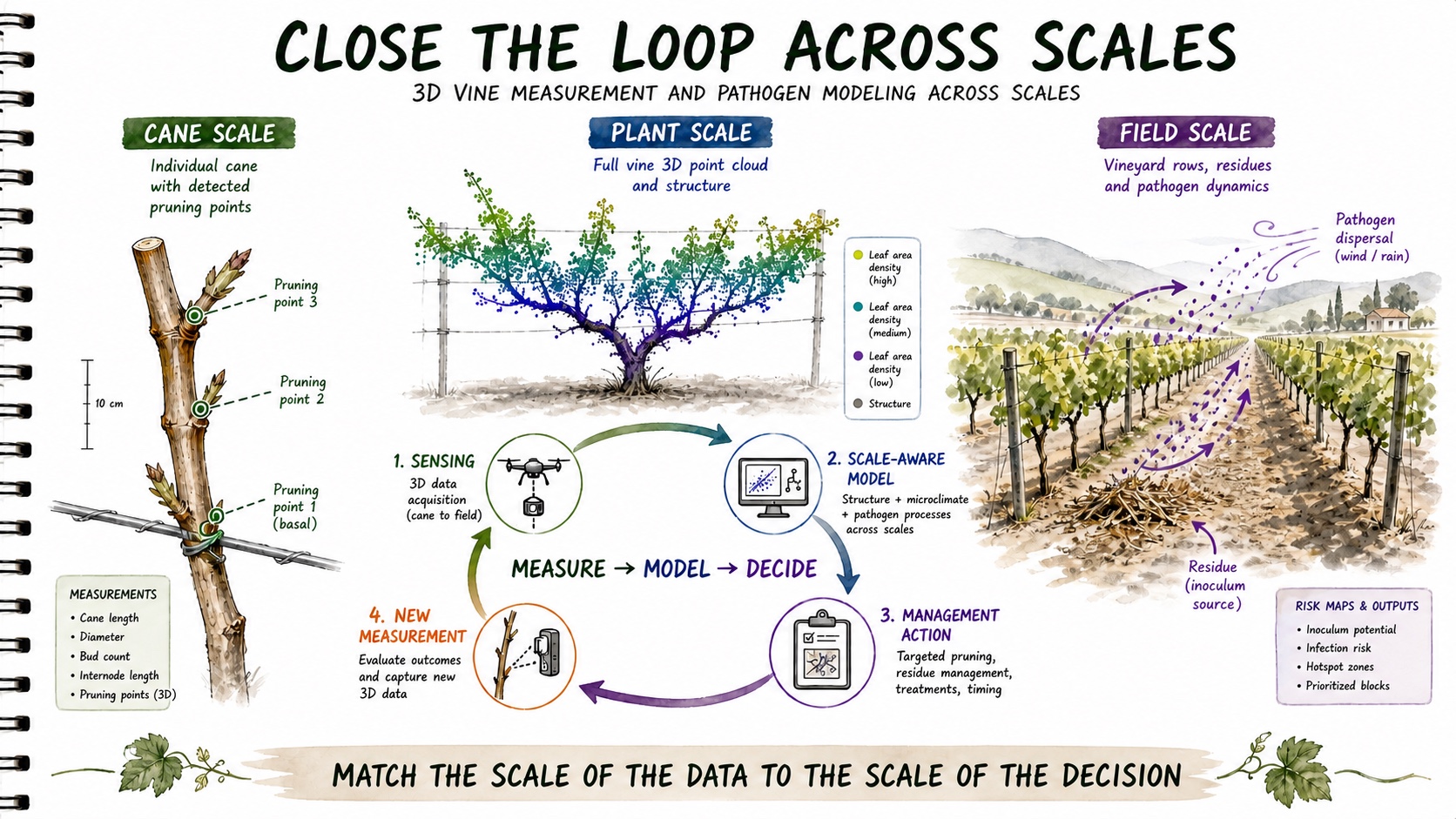
Today I'm thinking about a small but consequential seam in plant health research: the interface between how we measure plants (increasingly with high-resolution structure and imaging) and how we model plant-pathogen dynamics across space, time, and residues. For grapevine systems in particular, this seam matters because management decisions are often made at the scale of individual canes and pruning cuts, while pathogen survival and spread can be shaped by residue microbiomes and field-scale processes.
Why this matters
Plant disease management is often framed as a choice among interventions, sanitation, pruning, cultivar choice, sprays, but the effectiveness of any intervention depends on two things we frequently treat separately: (1) the geometry of the host (where tissue is, what gets removed, what remains) and (2) the ecology of the pathogen (where it survives, how it reproduces, and how it moves across spatial scales).
On the ecology side, crop residues are not just inert 'trash' to be removed; they form an ecotone between plant and soil where microbiomes can influence pathogen survival. The idea that residue-associated microbial communities and environmental conditions shape persistence provides a mechanistic basis for why sanitation sometimes works and sometimes disappoints, because 'residue' is a living habitat, not a uniform substrate. This perspective is developed in the arXiv preprint on microbiomes and pathogen survival in crop residues, which emphasizes residues as a transition zone linking plant and soil processes and affecting pathogen fate.
On the spatial side, pathogen reproductive success is scale-dependent. A pathogen's fitness can change when you zoom from leaf lesions to fields, or from a single vine to a block. The preprint on spatial scales and reproductive fitness of plant pathogens formalizes how spatial structure and scale can alter evolutionary and epidemiological outcomes. For viticulture, this resonates with everyday practice: a pruning decision is hyper-local, but inoculum pressure and dispersal are not.
The missing link is often measurement: if we can quantify vine structure precisely and consistently, we can connect local management actions (like pruning point selection) to models of inoculum production, dispersal, and survival. That's where recent work in grapevine structure extraction and pruning automation becomes relevant, not as 'robotics for its own sake,' but as a way to generate standardized, high-resolution phenotypes that can be integrated with plant-pathogen interaction models.
What changed today
Two grapevine-focused arXiv preprints highlight a practical shift: grapevine architecture is becoming machine-readable at scale.
One direction is explicit 3D reconstruction. The preprint on accurate 3D grapevine structure extraction from high-resolution point clouds focuses on extracting grapevine structure from dense 3D data. Even without diving into every algorithmic detail, the headline is important for plant health: when structure can be extracted reliably from point clouds, we can begin to treat canopy and woody architecture as quantitative variables rather than qualitative descriptors. That opens the door to linking structure to microclimate, wound distribution, and potential infection courts, especially relevant in grapevine virology and trunk disease contexts where spatial arrangement of tissues matters.
A second direction is task-oriented 2D modeling for pruning. The preprint on grapevine winter pruning automation targets detection of potential pruning points via segmentation and 2D plant modeling. This is a management-adjacent output: pruning points are not just geometry; they are decisions that influence tissue age distribution, wound placement, and the amount/type of residue left behind. If pruning point detection becomes strong, it could enable consistent pruning strategies across workers, seasons, and sites, creating cleaner 'intervention datasets' for downstream epidemiological analysis.
What's notable is that these advances are not framed as pathogen studies, yet they can materially affect how we study pathogens. Better structural data can reduce noise in field studies, improve covariate measurement (e.g., cane density proxies), and support mechanistic hypotheses about where infections establish and persist.
My research angle
My interest sits at the intersection of grapevine health, plant-pathogen interactions, and the multi-scale measurement problem. I'm not treating structure extraction or pruning automation as endpoints; I'm treating them as instrumentation for biological questions.
Here are three angles I want to explore next:
-
Residue ecology meets vine geometry. The crop-residue ecotone framing suggests that what remains after pruning (and how it contacts soil, how it decomposes, and what microbiome colonizes it) can influence pathogen survival. If we can quantify pruning outputs, amount of woody residue, size distribution, spatial placement, we can start testing residue-driven hypotheses more rigorously. This is where 3D structure extraction and pruning point detection could provide standardized inputs for residue-focused experiments.
-
Scale-aware epidemiology with measurable structure. The spatial-scale fitness perspective implies that disease outcomes depend on the scale at which processes operate. Vine structure is inherently multi-scale (bud, spur, cane, cordon, whole vine). If we can measure structure consistently, we can ask: at what structural scale do management actions most strongly affect pathogen fitness? For example, does altering spur density change local humidity enough to matter, or is the dominant effect mediated through residue and inoculum carryover? The spatial-scale framework provides a conceptual backbone for designing those comparisons.
-
Toward integrative phenotyping for stress and disease. A related preprint proposes a gene-expression biomarker indicating plant water status across controlled and natural environments. While it is not a disease paper per se, it reinforces a broader point: plant status (water, stress) can be quantified with biomarkers that generalize across contexts. In viticulture, water status interacts with canopy structure and potentially with disease susceptibility and symptom expression. I'm interested in how structural phenotypes (from imaging) and physiological phenotypes (from expression biomarkers) could be combined, an early step toward multi-omics thinking, even if the sources here focus on specific modalities.
Across these angles, the practical goal is improved management inference: being able to say not only 'this intervention reduced disease,' but "it reduced disease because it changed measurable structural and ecological variables that matter at the relevant spatial scale." That kind of inference is what ultimately supports strong formulation and management strategies, whether the intervention is mechanical (pruning), ecological (residue handling), or chemical/biological (where nanoencapsulation and formulation questions may later enter the picture).
References
- Microbiomes and pathogen survival in crop residues, an ecotone between plant and soil
- The effect of spatial scales on the reproductive fitness of plant pathogens
- A biomarker based on gene expression indicates plant water status in controlled and natural environments
- Accurate 3D Grapevine Structure Extraction from High-Resolution Point Clouds
- Grapevine Winter Pruning Automation: On Potential Pruning Points Detection through 2D Plant Modeling using Grapevine Segmentation