When Effector Structure Rewrites the Playbook: Lessons from Phytophthora to Grapevine
New structural insights into Phytophthora effectors challenge sequence-based predictions, while 3D canopy reconstruction and residue ecology offer fresh angles on vineyard disease risk.

Prem Pratap Singh
February 26, 2026 · 5 min read
Plant health research keeps reminding me that 'what we think we know' can hinge on a few structural details, a few millimeters of spatial scale, or a few overlooked microbial niches. Today's reading list spans that spectrum, from molecular architecture of pathogen effectors to the ecology of residues and the practical geometry of grapevine canopies, offering a useful prompt to connect plant-pathogen interactions with the kinds of multi-omics and field-facing questions I care about.
Why this matters
Plant disease management is often framed as a choice among genetics, chemistry, and agronomy. In practice, it's a systems problem: pathogens deploy effectors to manipulate host immunity; their success depends on where and when they reproduce; and their persistence is shaped by the microbial communities and physical environments they inhabit between seasons. Each layer can become a use point for management or a blind spot that undermines it.
For grapevine systems in particular, the 'systems' view is unavoidable. Vine architecture influences microclimate and spray coverage; residue and soil interfaces can act as reservoirs; and the timing of interventions is constrained by phenology and operations (e.g., pruning). That makes it valuable to track advances that tighten the link between mechanism (how pathogens work) and measurement (how we observe vines and environments at scale).
What changed today
Two themes stood out.
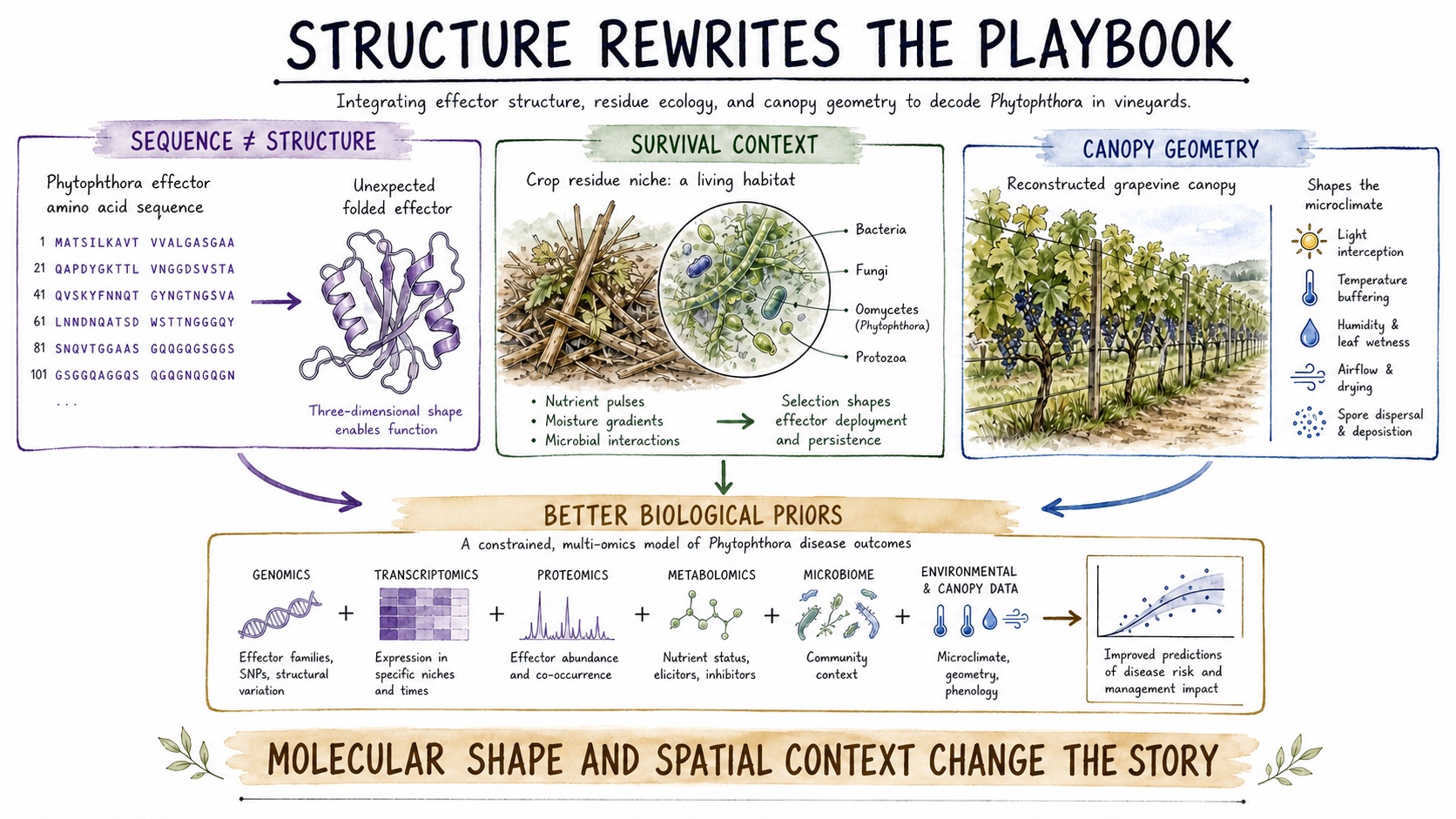
First, structural biology is continuing to reshape how we interpret pathogen effectors. A news summary highlighted 'novel structural insights' into Phytophthora effectors that challenge long-held assumptions in plant pathology. Even without diving into every technical detail, the key takeaway is methodological: structure can overturn inference based on sequence motifs or historical classification. For plant-pathogen interactions, that matters because effector families are often used to predict function, host targets, or evolutionary constraints. When structure revises those assumptions, it can ripple into how we prioritize candidate effectors for functional assays, resistance screening, or comparative analyses across pathosystems.
Second, the field is steadily improving its ability to quantify the plant and its context, both biologically and geometrically. On the ecological side, crop residues are framed as an 'ecotone between plant and soil,' where microbiomes influence pathogen survival. That residue niche is a practical management frontier: it's where inoculum can persist, where microbial antagonists may suppress pathogens, and where environmental conditions (moisture, temperature, decomposition) modulate outcomes. On the geometric/phenotyping side, new work on extracting accurate 3D grapevine structure from high-resolution point clouds underscores how quickly canopy-scale measurement is advancing. Even when a paper is not explicitly about disease, the ability to reconstruct vine architecture with high fidelity is directly relevant to epidemiology (humidity pockets, leaf wetness duration), precision management (targeted spraying), and experimental design (quantifying structural covariates that confound disease phenotypes).
Together, these threads point to a broader 'change': better structure at the molecular level and better structure at the canopy level. Both reduce ambiguity, one about what pathogen proteins can do, the other about what the host environment looks like in situ.
My research angle
My long-term interest sits at the intersection of grapevine health, plant-pathogen interactions, and multi-omics-informed management. Today's sources suggest a few concrete directions.
1) Use structural insights to sharpen multi-omics hypotheses. Multi-omics datasets (transcriptomics, proteomics, metabolomics) can be hypothesis-generating but also noisy. If effector structure revises functional expectations, it can help constrain models: which host pathways are plausible targets, which interaction interfaces are likely, and which timepoints might capture the host response. In grapevine virology and broader pathogen work, I see value in treating structural information as a prior, not replacing omics, but guiding it toward testable mechanisms.
2) Treat residues as a measurable, engineerable compartment. The crop residue ecotone framing resonates with management questions: what microbial consortia correlate with lower pathogen survival, and can we shift them predictably? This is where formulation and delivery concepts (including nanoencapsulation, in my broader interests) become relevant, not as a buzzword, but as a way to stabilize biologicals or small molecules in harsh residue environments and release them over time. The arXiv perspective on microbiomes and pathogen survival in residues encourages thinking beyond 'spray the canopy' toward 'manage the off-season habitat,' with microbiome-aware metrics.
3) Connect spatial scale to epidemiological interpretation. The effect of spatial scales on pathogen reproductive fitness is a reminder that 'scale' is not a technicality; it changes conclusions. In vineyards, spatial scale spans lesions on leaves, clusters within a canopy, rows across a block, and blocks across a region. If reproductive success depends on spatial structure, then sampling design, intervention placement, and even how we aggregate sensor data can bias our understanding of what works. I'm interested in pairing canopy structure extraction (3D point clouds) with disease observations to test whether architectural features explain variance in infection or treatment response, especially in real-world blocks where microclimate heterogeneity is high.
4) Make vine structure a first-class variable in disease studies. Accurate 3D grapevine reconstruction is not only an automation or robotics milestone; it's a missing covariate in many plant pathology datasets. If we can quantify shoot density, leaf area distribution, and occlusion patterns, we can better interpret why two vines with similar genotype and treatment diverge in disease severity. This also complements pruning automation and segmentation work: operational datasets collected for vineyard management could double as phenotyping layers for health research, provided we design pipelines with that dual use in mind.
today's reading reinforces a research posture I want to keep: integrate mechanistic insight (effectors, host responses) with environmental persistence (residues, microbiomes) and measurable structure (3D canopy), then translate that into management concepts that are testable and scalable in vineyards.
References
- Novel structural insights into Phytophthora effectors challenge long-held assumptions in plant pathology - Phys.org
- Microbiomes and pathogen survival in crop residues, an ecotone between plant and soil
- The effect of spatial scales on the reproductive fitness of plant pathogens
- Accurate 3D Grapevine Structure Extraction from High-Resolution Point Clouds