Gene-Expression Biomarkers for Water Status: A Missing Piece in Plant-Pathogen Field Studies
How a transferable gene-expression biomarker for plant water status could reduce confounding in field omics, and why canopy architecture and residue ecology complete the picture.

Prem Pratap Singh
February 23, 2026 · 6 min read
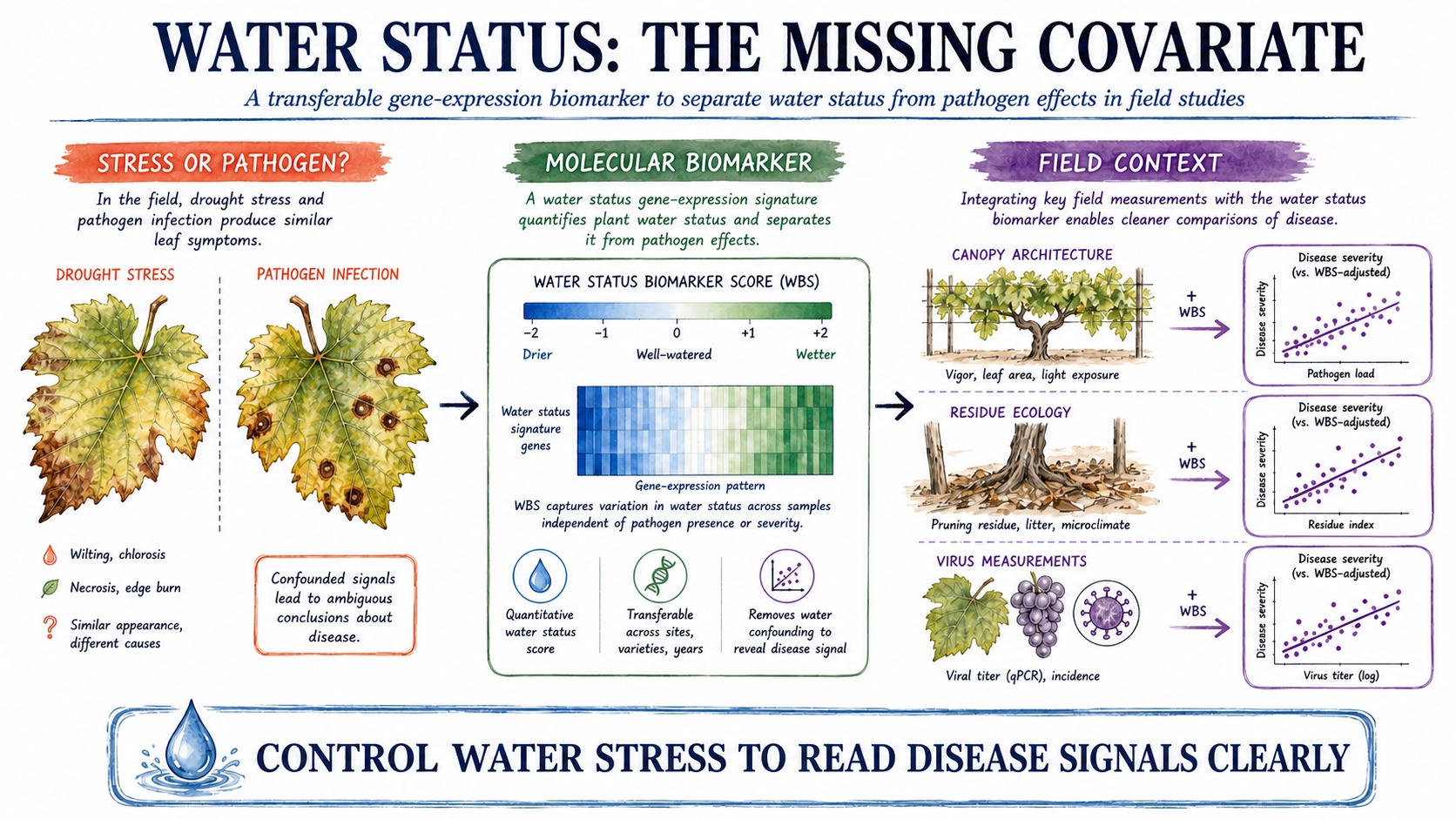
Today's reading pulled me back to a recurring theme in my work on grapevine systems: the most useful biological insight often arrives when we connect measurement (sensing, imaging, biomarkers) with mechanism (pathogen fitness, survival niches, host responses). Across plant-pathogen interactions and grapevine phenotyping, the field keeps moving toward integrated, multi-scale evidence, exactly the kind of foundation we need for practical management decisions in vineyards and beyond.
Why this matters
For plant health management, whether the goal is reducing disease pressure, improving water-use decisions, or designing interventions that scale internationally, two gaps repeatedly slow progress.
First, we often lack actionable state variables: measurements that reliably summarize plant status (e.g., water stress) or disease risk in a way that holds up outside controlled experiments. A biomarker that works in a growth chamber but fails in the field is scientifically interesting, but operationally fragile.
Second, we still struggle to connect spatial structure to biological outcomes. Pathogens do not experience a field as a uniform plane; they experience microhabitats, residues, canopy architecture, and dispersal constraints. Likewise, grapevine management decisions (pruning, canopy shaping) alter plant structure in ways that can influence microclimate and, indirectly, pathogen dynamics. Bridging these scales, molecular to canopy, residue to soil, plot to field, is central to plant-pathogen interactions and to grapevine research that aims to be predictive rather than descriptive.
The sources below collectively reinforce that the next step is not 'more data' alone, but better alignment between what we measure (gene expression, images, point clouds) and what we need to decide (irrigation timing, sanitation strategies, disease risk mitigation, labor automation).
What changed today
Three threads stood out in today's set of papers.
1) Biomarkers are being framed as transferable indicators, not just correlates. The arXiv preprint on a gene-expression biomarker for plant water status emphasizes performance across both controlled and natural environments, which is exactly the bar that matters for deployment in real production settings (A biomarker based on gene expression indicates plant water status in controlled and natural environments). Even without diving into every methodological detail, the key idea is that expression-based signatures can serve as compact indicators of physiological state, potentially complementing sensor data (soil moisture, weather) when those proxies become unreliable.
2) Crop residues are being treated as an 'ecotone' that shapes pathogen survival. The crop-residue microbiome perspective highlights residues as a boundary zone between plant and soil, where microbial communities and environmental conditions influence pathogen persistence (Microbiomes and pathogen survival in crop residues, an ecotone between plant and soil). This framing matters because many management practices, mulching, tillage, residue removal, composting, operate directly on this interface. If residues are a survival reservoir, then 'field hygiene' is not a generic recommendation; it becomes a targeted ecological intervention.
3) Grapevine structure extraction is accelerating, from 2D segmentation to high-resolution 3D point clouds. Two grapevine-focused works show a clear progression: detecting pruning points through 2D plant modeling and segmentation (Grapevine Winter Pruning Automation: On Potential Pruning Points Detection through 2D Plant Modeling using Grapevine Segmentation) and extracting accurate 3D grapevine structure from high-resolution point clouds (Accurate 3D Grapevine Structure Extraction from High-Resolution Point Clouds). Together, they suggest that canopy architecture is becoming quantifiable at a fidelity that could support not only automation, but also biological inference: canopy density, shoot positioning, and pruning choices can be translated into structural metrics that relate to microclimate and, potentially, disease-conducive conditions.
A fourth thread ties these together conceptually: pathogen fitness depends on spatial scale. The work on spatial scales and reproductive fitness of plant pathogens underscores that conclusions about pathogen success can change depending on the scale at which we observe and model processes (The effect of spatial scales on the reproductive fitness of plant pathogens). This resonates with the residue ecotone idea (micro-scale survival niches) and with grapevine architecture (meso-scale canopy structure).
My research angle
My long-term interest sits at the intersection of grapevine virology, plant-pathogen interactions, and multi-omics, while keeping an eye on translation into management. Today's sources suggest a practical synthesis path:
Link structural phenotyping to pathogen-relevant microenvironments. High-resolution 3D structure extraction in grapevine can be more than a robotics milestone. If we can quantify canopy porosity, leaf-area distribution, and pruning-derived architecture, we can begin to model microclimate proxies (humidity retention, drying time after rain/dew) that influence infection windows. The pruning automation work provides a bridge from imagery to actionable decisions (where to cut), while 3D extraction offers a route to richer structural descriptors. The research opportunity is to connect these descriptors to disease risk models, especially for pathogens sensitive to canopy microclimate.
Treat residues and soil-plant boundaries as part of the disease system, not background. The residue ecotone framing encourages me to think of vineyard floor management as a microbiome and survival-ecology lever. In grape systems, residues (prunings, leaf litter) and their microbial communities could influence inoculum carryover for certain diseases. The key is to move from general statements ('residues matter') to measurable hypotheses: which residue handling practices shift microbial community trajectories in ways that reduce pathogen survival?
Use biomarkers as 'state estimators' that can be fused with phenotyping. A gene-expression biomarker for water status suggests a template for building compact molecular readouts that can be validated across environments. In vineyards, water status influences vigor and canopy density, which in turn affects disease-conducive microclimates. A research direction I find compelling is data fusion: combine a molecular state estimator (expression signature) with structural phenotyping (2D/3D canopy metrics) to better predict management-relevant outcomes. This is where multi-omics can be disciplined: not omics for its own sake, but omics that improves decision confidence.
Keep spatial scale explicit in models and experiments. The spatial-scale dependence of pathogen fitness is a reminder to design studies that declare their scale assumptions. For example, if we measure canopy structure at vine scale but model pathogen dispersal at block scale, we should be explicit about what is averaged out and what is preserved. This also informs how I think about international transferability: practices and models that work in one region may fail elsewhere if the dominant spatial processes differ (e.g., field heterogeneity, residue management norms, cultivar training systems).
Finally, while not covered directly in these sources, I'm continually thinking about formulation and delivery, nanoencapsulation and other approaches, as future tools for targeted, lower-dose interventions. The ecological and structural insights above help define where and when such interventions would matter most, and what success metrics should look like.
References
- A biomarker based on gene expression indicates plant water status in controlled and natural environments
- Microbiomes and pathogen survival in crop residues, an ecotone between plant and soil
- Grapevine Winter Pruning Automation: On Potential Pruning Points Detection through 2D Plant Modeling using Grapevine Segmentation
- Accurate 3D Grapevine Structure Extraction from High-Resolution Point Clouds
- The effect of spatial scales on the reproductive fitness of plant pathogens