Genome Resurrection, 3D Vine Mapping, and Why Between-Season Reservoirs Matter
Pathogen host-jumping traced through genome resurrection, 3D grapevine structural phenotyping from point clouds, and crop residue ecology as a missing link in vineyard disease management.

Prem Pratap Singh
February 19, 2026 · 6 min read
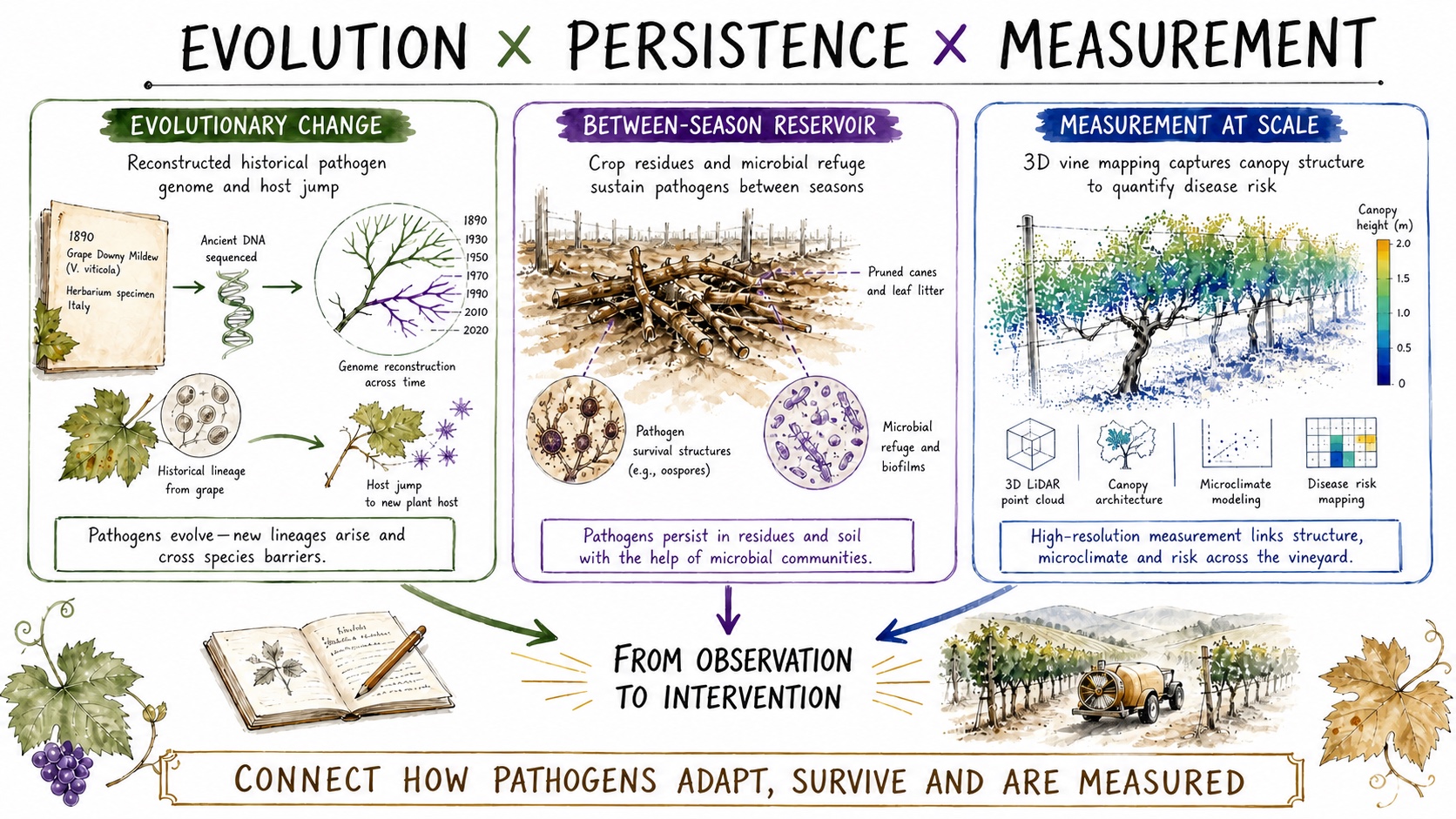
Plant health research often advances in small, technical steps, new genomic reconstructions, better ecological framing, or improved sensing and phenotyping. Today's reading cluster reinforced a theme I keep coming back to: the most actionable insights in plant-pathogen systems emerge when we connect evolutionary change (how pathogens adapt), ecological persistence (where they survive between seasons), and measurement (how we observe plants and pathogens at scale).
Why this matters
Plant disease management is increasingly constrained by three realities. First, pathogens evolve quickly, sometimes in ways that defeat resistant cultivars or outrun surveillance. Second, many epidemics are 'made' in the off-season: inoculum persists in residues, soils, and surrounding vegetation, then re-enters crops when conditions align. Third, our ability to respond depends on measurement, how precisely we can phenotype plants, map canopies, and detect stress signals early enough to matter.
For my own interests, grapevine systems, plant-pathogen interactions, and multi-omics, this triad is especially relevant. Grapevines are perennial, structurally complex, and managed across years; that makes carryover inoculum and spatial processes central. At the same time, viticulture is rapidly adopting sensing and automation, which creates an opportunity: if we can align high-resolution phenotyping with ecological and evolutionary models, we can move from reactive control to anticipatory management.
What changed today
Two threads stood out.
1) Pathogen evolution is being reframed through 'genome resurrection' and species-jumping dynamics. A news report highlighted work on a fungal threat to coffee crops, emphasizing the idea that reconstructing ('resurrecting') fungal genomes can help understand how pathogens shift hosts and adapt over time. While the piece is not a methods paper, it underscores a broader direction: using comparative and historical genomics to infer the genetic changes associated with host range expansion and emergence events. That framing resonates with plant-pathogen interaction research more generally, especially where host jumps or rapid adaptation are suspected drivers of new outbreaks. (I'm deliberately not extrapolating beyond what's described, but the signal is clear: evolutionary reconstruction is becoming a practical tool for risk understanding.) Source: the Phys.org article linked in the references below.
2) The 'between-season' habitat is not a footnote, it's an ecotone with its own rules. The arXiv preprint on microbiomes and pathogen survival in crop residues treats residues as an ecotone between plant and soil, where microbial communities and environmental conditions shape pathogen persistence. This is important because it shifts management thinking from 'kill the pathogen in the crop' to 'manage the habitat that enables survival and reintroduction.' Even without prescribing specific interventions, the conceptual model encourages integrated strategies: residue handling, soil health, and microbiome-aware approaches as part of disease suppression.
Alongside these biological insights, today's set also included work that strengthens the measurement layer:
- A preprint on extracting accurate 3D grapevine structure from high-resolution point clouds points to the maturation of structural phenotyping for grapevines. If canopy architecture can be reconstructed reliably, it becomes feasible to link structure to microclimate, spray coverage, and potentially disease risk, without relying solely on manual scoring.
- A related preprint on winter pruning automation uses 2D plant modeling and segmentation to detect potential pruning points. Even though this is framed as robotics/automation, it matters biologically: pruning decisions affect canopy density, airflow, and inoculum dynamics across seasons.
Taken together, today's 'change' is less about a single breakthrough and more about convergence: evolutionary genomics to understand emergence, ecological framing to understand persistence, and phenotyping/automation to measure and act.
My research angle
My working hypothesis is that durable disease management in perennial crops will come from closing the loop between (i) pathogen evolutionary potential, (ii) ecological reservoirs, and (iii) plant structural and physiological state. The sources today suggest concrete ways to tighten that loop.
Linking residues, microbiomes, and pathogen carryover to vineyard realities. Residues in annual crops are an obvious focus, but vineyards also have persistent organic matter (prunings, leaf litter, mummified clusters in some contexts) and stable soil-plant interfaces. The 'ecotone' framing encourages me to think about vineyard floor management and residue decomposition as part of the pathogen life cycle, not just sanitation. A multi-omics angle could be: characterize residue-associated microbiomes and functional potential, then relate that to pathogen survival metrics and subsequent season pressure. The arXiv residue paper provides a conceptual scaffold for that kind of study design.
Spatial scale as a design variable, not just a nuisance. Another arXiv preprint in today's list examines how spatial scales affect the reproductive fitness of plant pathogens. For vineyards, spatial scale is everything: vine-to-vine connectivity, row structure, block-level heterogeneity, and field context. If pathogen fitness changes with spatial scale, then management can be tuned accordingly: e.g., targeted interventions where connectivity is highest, or structural canopy modifications that reduce effective transmission. This is where structural phenotyping (3D point clouds) becomes more than a tech demo: it can parameterize spatially explicit epidemiological models.
Structural phenotyping as a bridge to mechanistic plant-pathogen models. The grapevine 3D reconstruction preprint suggests a pathway to quantify architecture (cordon geometry, shoot density proxies, canopy porosity) at scale. Pair that with disease observations and microclimate measurements, and we can start testing mechanistic links: does a specific architectural trait consistently predict disease-conducive microclimates? Can pruning automation outputs (candidate pruning points) be repurposed as standardized descriptors of canopy management intensity? The pruning automation paper hints that these descriptors could be extracted routinely, which is essential for longitudinal studies.
Where nanoencapsulation and formulation thinking could fit (carefully). My longer-term interests include formulation and nanoencapsulation, but today's sources are not about delivery systems. Still, they inform where formulation innovations might matter most: if residues and microhabitats are key survival zones, then delivery strategies (biologicals, elicitors, or protective compounds) might need to be designed for persistence and activity in those ecotones, not just on leaf surfaces. Any such step would need dedicated evidence beyond today's reading, but the ecological framing helps define the target environment.
the actionable takeaway for my own research planning is methodological: prioritize datasets that are jointly interpretable across scales, genomic/evolutionary signals, residue/soil microbiome context, and high-resolution canopy structure, so that management recommendations can be grounded in mechanisms rather than correlations alone.
References
- Fungus with species-jumping genes threatens coffee crops - Phys.org
- Microbiomes and pathogen survival in crop residues, an ecotone between plant and soil
- The effect of spatial scales on the reproductive fitness of plant pathogens
- Accurate 3D Grapevine Structure Extraction from High-Resolution Point Clouds
- Grapevine Winter Pruning Automation: On Potential Pruning Points Detection through 2D Plant Modeling using Grapevine Segmentation