Mycotoxin Pressure, Incomplete Omics, and Nanocarriers: Connecting the Dots for Plant Health
Rising mycotoxin risks, methods for integrating incomplete multi-omics datasets, and metal-organic nanocarriers for targeted delivery - three threads that converge on smarter crop disease management.

Prem Pratap Singh
February 16, 2026 · 6 min read
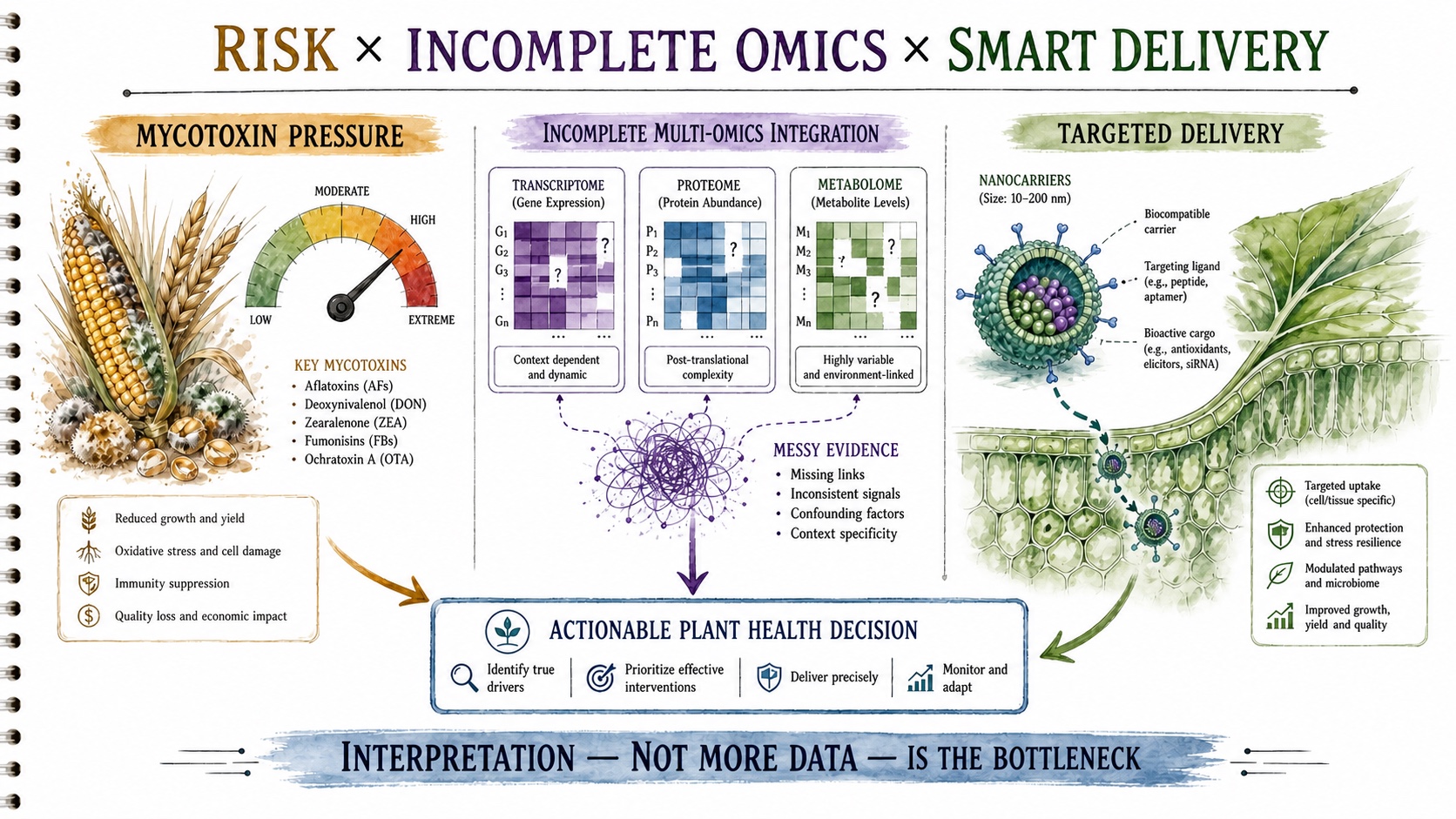
Today's reading pulled me in two directions that I think belong in the same conversation: (1) the very practical problem of rising mycotoxin pressure in food and feed systems, and (2) the fast-moving methodological field for integrating messy, incomplete multi-omics data. For my own work interests, grapevine virology and broader plant-pathogen interactions, this combination feels especially relevant because the bottleneck is rarely 'more data,' but rather 'actionable interpretation' that can inform management and formulation choices.
Why this matters
Plant health research increasingly sits at the intersection of ecology, molecular biology, and management. On one end, we have real-world risk signals, like reports of increasing mycotoxin risk across global feed markets, which translate directly into economic losses and food safety concerns, including aflatoxin-related issues in susceptible supply chains. On the other end, we have a growing toolkit for multi-omics integration that promises to connect genotype, expression, microbiome context, and phenotype, yet often struggles with incomplete datasets and mismatched sampling designs.
For plant-pathogen interactions, context is everything. Pathogen survival and inoculum dynamics don't occur in a vacuum; they are shaped by the 'ecotone' between plant and soil, including crop residues and associated microbiomes. That ecological layer influences disease carryover and the baseline pressure that management must contend with. At the same time, host-pathogen genetic incompatibilities can drive dramatic outcomes (e.g., hybrid necrosis models), reminding us that mechanistic insights can emerge from carefully framed models, even when they don't immediately map onto field-scale management.
The practical implication for a grapevine-focused program is clear: if we want better disease and toxin management, we need approaches that bridge scales, from residue microbiomes and field spatial structure to within-host molecular responses, and we need delivery/formulation technologies that can translate those insights into interventions.
What changed today
Two 'today' signals stood out in the source set.
First, the industry-facing update: DSM-Firmenich is flagging rising mycotoxin risk across global feed markets. While the details matter (and should be read directly in the report), the key takeaway is that mycotoxin risk is being framed as dynamic and geographically broad, an operational reality for monitoring programs and mitigation strategies, not a static hazard. For researchers, it's a reminder that surveillance, prediction, and mitigation need to be treated as a coupled system rather than separate silos.
Second, on the methods and technology side, there's continued attention to nanocarrier approaches for pesticide delivery: specifically metal, organic frameworks (MOFs) as nanocarriers. This matters for 'formulation' thinking: controlled release, stability, and targeted delivery are not just engineering details; they shape exposure profiles in planta and in the environment, which in turn can influence pathogen pressure and non-target effects. Even if one's primary focus is virology (as mine often is), delivery platforms are part of the management conversation, especially when aiming to reduce chemical load while maintaining efficacy.
In parallel, multi-omics integration methods continue to evolve. CLCLSA proposes a cross-omics linked embedding approach using contrastive learning and self-attention, explicitly targeting incomplete multi-omics data. That design choice, treating incompleteness as a first-class constraint rather than an afterthought, aligns with what we see in plant systems, where field sampling, seasonal constraints, and budget realities routinely produce missing modalities. Separately, STProtein focuses on predicting spatial protein expression from multi-omics data, reinforcing a broader trend: moving from bulk averages toward spatially resolved inference. Even when a given method is developed outside plant pathology, the conceptual direction (spatial + multi-omics) is highly transferable to plant tissues and infection fronts.
My research angle
I'm interested in how we can connect three layers into a coherent research and management pipeline for grapevine systems:
-
Ecological persistence and inoculum context (residues, soil, microbiomes). Crop residues form a boundary zone between plant and soil where microbiomes can influence pathogen survival. For grapevine disease complexes, analogous 'reservoir' thinking applies, whether in vineyard floor residues, pruning debris, or surrounding vegetation. The arXiv review on microbiomes and pathogen survival in crop residues provides a useful conceptual scaffold for designing sampling that captures both pathogen presence and the microbial context that may suppress or help persistence.
-
Mechanistic host-pathogen models that explain sharp phenotypes. Hybrid necrosis models highlight how specific genetic interactions can produce strong, sometimes speciation-linked outcomes. While grapevine virology often emphasizes virus, host compatibility and symptom expression, the broader lesson is methodological: strong phenotypes can be use to identify causal pathways, which can then be tested in more complex backgrounds. This is where multi-omics becomes valuable, if integrated carefully.
-
Multi-omics integration under real constraints, plus translation via formulation/delivery. In grapevine work, we rarely get perfect matched datasets (transcriptome, proteome, metabolome, microbiome, spatial context) across all samples and timepoints. Methods like CLCLSA, designed for incomplete multi-omics, are therefore appealing as a research backbone: they suggest a way to learn shared representations even when some modalities are missing. Meanwhile, spatial inference approaches like STProtein point toward capturing heterogeneity, critical in plant tissues where infection is patchy and vascular transport creates gradients.
Where does nanoencapsulation fit? I see it as a translation layer. If we can identify molecular or ecological use points, say, a stage where pathogen establishment is most vulnerable, or a microbiome shift that correlates with reduced survival, then controlled delivery systems (including MOF-based nanocarriers) could, in principle, support more precise interventions. The goal is not 'nano for nano's sake,' but better alignment between what we learn (multi-omics + ecology) and what we do (management + formulation). This is also where food and feed safety concerns, including aflatoxin risk signals, keep the work grounded: interventions should ultimately reduce downstream risk, not just shift symptoms.
A final note: spatial scale keeps coming up implicitly across these sources, residue microhabitats, tissue-level heterogeneity, and field-level patterns. The arXiv work on spatial scales and pathogen reproductive fitness is a useful reminder that the 'right' scale of measurement and intervention is not automatic. For vineyards, that translates into practical questions: Are we sampling at the vine, block, or field level? Are we targeting within-canopy microclimates, vineyard floor reservoirs, or vector dynamics? Multi-omics can help, but only if the sampling design respects the spatial biology of the system.
References
- World Mycotoxin Survey - dsm-firmenich
- Recent advances in metal-organic framework nanocarriers for pesticide delivery - Frontiers in Plant Science
- Microbiomes and pathogen survival in crop residues, an ecotone between plant and soil
- Speciation due to hybrid necrosis in plant-pathogen models
- The effect of spatial scales on the reproductive fitness of plant pathogens
- CLCLSA: Cross-omics Linked embedding with Contrastive Learning and Self Attention for multi-omics integration with incomplete multi-omics data
- STProtein: predicting spatial protein expression from multi-omics data