Grapevine Virology in 2026: Where Multi-Omics Meets the Vineyard
An overview of recent advances in grapevine-virus interactions, multi-omics integration, and how these tools are shaping sustainable viticulture research.

Prem Pratap Singh
February 14, 2026 · 4 min read
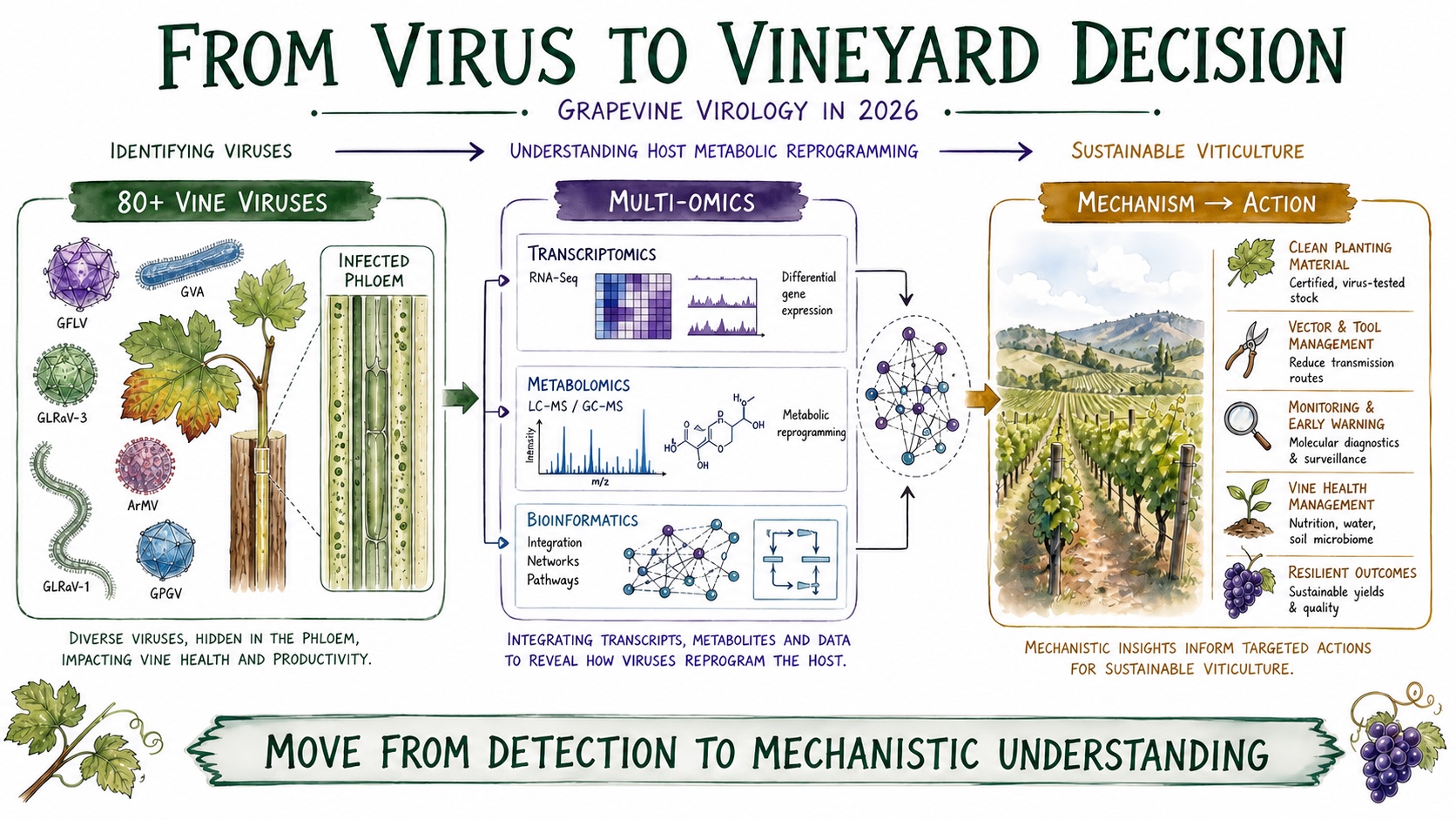
Grapevine viruses remain one of the most persistent threats to global viticulture. With over 80 viruses documented in Vitis vinifera alone, the challenge is not just identifying these pathogens but understanding how they reprogram host metabolism at a molecular level. Recent work, including research from our group at UC Davis, is beginning to answer that question using multi-omics approaches that combine transcriptomics, metabolomics, and bioinformatics.
Why this matters
Grapevine red blotch virus (GRBV) and grapevine leafroll-associated viruses (GLRaVs) cause significant economic losses across wine-growing regions worldwide. These viruses alter berry composition, delay ripening, and reduce phenolic and anthocyanin content, directly impacting wine quality and grower revenue. Yet our understanding of the molecular mechanisms underlying these changes has historically been limited to single-omics studies.
The integration of RNA-Seq with GC-MS and LC-MS/MS metabolite profiling is now enabling researchers to map complete host-response networks. This systems-level view reveals how virus infection rewires phenylpropanoid biosynthesis, sugar metabolism, and defense signaling pathways in grapevine tissues, insights that were invisible when examining transcriptomic or metabolomic data in isolation.
Recent developments
Several advances in the past year have accelerated progress in this field:
Spatial transcriptomics in plant-pathogen systems. New single-cell and spatial RNA-Seq methods are being adapted for plant tissues, allowing researchers to resolve infection dynamics at the cellular level rather than averaging across bulk tissue samples. This is particularly relevant for grapevine viruses, which often show uneven distribution across leaf and berry tissues.
Improved annotation of grapevine secondary metabolite pathways. Updated genome assemblies and functional annotations for V. Vinifera are improving our ability to link differentially expressed genes to specific metabolic shifts detected by mass spectrometry. This closes a major gap in multi-omics integration pipelines.
Nano-delivery systems for vineyard disease management. Chitosan-based nanoencapsulation of bioactive compounds is emerging as a promising strategy for sustainable pathogen management. These systems can provide controlled release of antifungal agents while reducing chemical inputs, an approach I explored extensively during my doctoral work on aflatoxin-producing Aspergillus species.
My research perspective
At UC Davis, my current work focuses on dissecting grapevine-GRBV interactions through integrated transcriptomic and metabolomic profiling. By combining DESeq2-based differential expression analysis with targeted and untargeted metabolomics (GC-MS, LC-MS/MS), we are building multi-layered maps of how GRBV infection reshapes berry development and defense responses across different grapevine cultivars.
One particularly interesting finding from our ongoing CDFA/USDA-funded projects is the extent to which GRBV disrupts the phenylpropanoid pathway, the same pathway responsible for producing the anthocyanins and tannins that define red wine character. Understanding this disruption at the gene-metabolite level could eventually inform breeding strategies for virus-tolerant rootstocks.
I also draw on my background in nanoencapsulation and food safety to think about downstream implications: how do virus-induced changes in berry chemistry affect postharvest quality and microbial safety? These are questions that sit at the intersection of plant pathology and food science, and they require the kind of cross-disciplinary thinking that multi-omics naturally encourages.
Looking ahead
The convergence of affordable sequencing, improved mass spectrometry sensitivity, and better computational tools means we are entering a period where multi-omics studies of grapevine-virus systems can move from descriptive to predictive. The goal is not just to catalog what changes upon infection, but to identify early biomarkers and intervention points that growers can act on.
For those interested in this space, I recommend exploring recent literature on plant virome characterization, pathway enrichment analysis in perennial crops, and the application of machine learning to multi-omics datasets in agricultural systems.
References
- Grapevine Red Blotch Disease: A Threat to the Grape and Wine Industries; Annual Review of Virology
- The Emerging Role of Omics-Based Approaches in Plant Virology; Viruses
- Chitosan Nanoparticles-Based Ionic Gelation Method: A Promising Candidate for Plant Disease Management; Polymers
- Moderated estimation of fold change and dispersion for RNA-seq data with DESeq2; Genome Biology
- Investigating Grapevine Red Blotch Virus Infection in Vitis vinifera L. Cv. Cabernet Sauvignon Grapes: A Multi-Omics Approach; IJMS