From Peach Defense Chemistry to Grapevine Sensing: What This Week Reveals About Smarter Plant Disease Management
New reports on plant defense compounds, nano-agrochemicals, and crop sensing point to a more precise way of managing disease and stress. For grapevine research, the message is clear: connect host responses, delivery systems, and field-scale phenotyping.

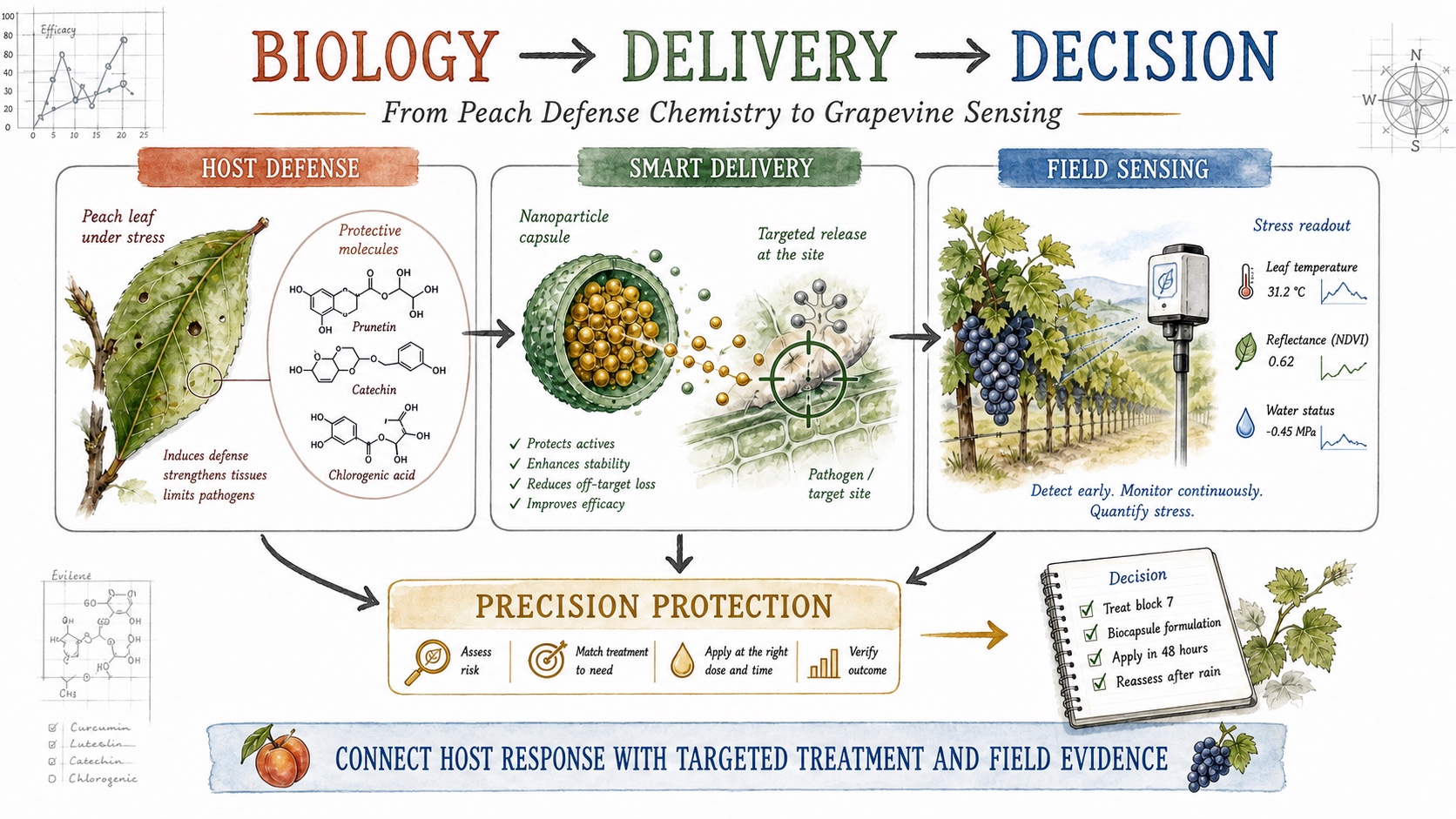
Plant disease management is moving toward precision, not just in detection but in how we interpret host responses and deliver treatments. The set of papers and reports I read today does not center on a single pathogen or crop, yet together they point to a useful direction for grapevine work: combining plant defense biology, improved delivery systems, and field-ready phenotyping.
Why this matters
In grapevine systems, disease pressure rarely acts alone. Viral infections, trunk diseases, bacterial problems, and abiotic stress often overlap in the same vineyard. That makes single-variable management weak. If we want better decisions, we need to know at least three things at once: what the plant is doing, what the pathogen is doing, and how our intervention actually reaches its target.
Two of today's items are especially relevant to that framing. One report describes how peaches use proanthocyanidins to slow the progression of a damaging bacterial disease. Even though this is not a grapevine study, it matters because it underscores a recurring theme in plant-pathogen interactions: host metabolites are not passive background signals; they can shape disease progression. In grapevine virology and broader grapevine pathology, this is a reminder that symptom expression may depend as much on host chemistry and stress state as on pathogen presence.
The second theme is delivery. The report on the use of nano-agrochemicals in sustainable agriculture and environmental protection suggests that crop protection is being pushed toward more targeted applications and lower collateral impacts. For plant disease management, that matters because efficacy is often limited by poor timing, poor persistence, or poor localization. In vineyards, where repeated sprays are costly and environmental constraints are real, the idea of more precise delivery deserves attention, especially for compounds that aim to induce host defenses or suppress vectors.
The phenotyping papers add another layer. High-resolution 3D grapevine structure extraction and automated pruning-point detection are not disease papers in the narrow sense, but they show how quickly vine-level structural data are becoming accessible. Once the architecture is well measured, it becomes easier to connect canopy structure, pruning decisions, spray penetration, microclimate, and disease risk. A separate arXiv paper on gene-expression biomarkers for plant water status is also useful here. Water status is a major modifier of disease outcomes, and in grapevine it often changes symptom severity, vine vigor, and management timing.
What changed today
The main change is not a single discovery. It is the clearer convergence of three lines of work.
First, host defense chemistry is being described in more actionable terms. The peach study links proanthocyanidins with slower bacterial disease development. That kind of result pushes us to ask sharper questions in perennial crops: which metabolites track resistance, tolerance, or delayed symptom development, and can they be measured early enough to guide management?
Second, crop protection delivery is being discussed with sustainability built into the design. The nano-agrochemical report frames targeted delivery as part of environmental protection, not just product performance. For researchers, this shifts the conversation from "does a compound work" to "can it be delivered at the right dose, place, and time with fewer side effects?" In grapevine systems, this could apply to antimicrobial compounds, elicitors, RNA-based approaches, or even vector-focused interventions.
Third, plant measurement is becoming more operational. The grapevine point-cloud paper shows that detailed structural extraction from high-resolution data is advancing. The pruning automation paper, though earlier, fits the same trend: vines can be modeled in ways that support decisions rather than just description. Add the water-status biomarker paper, and the picture becomes more interesting. We may be able to combine structural phenotyping with molecular stress readouts, then ask how those variables interact with pathogen load and symptom expression.
There is also a useful background reminder from the crop-residue microbiome paper and the spatial-scale pathogen fitness paper. Plant disease is not only a within-plant problem. Residues, soil interfaces, and spatial arrangement shape inoculum survival and spread. For vineyards, this matters when thinking about pruning debris, inter-row management, and block-level heterogeneity.
My research angle
My own interest sits at the intersection of grapevine virology, plant-pathogen interactions, multi-omics, and delivery systems. Today's reading reinforces a practical research agenda.
One part is to treat the host response as a measurable layer rather than just a consequence. In grapevine virus work, we often classify vines by infection status and visible symptoms. That is necessary, but incomplete. A stronger approach is to profile the host state across metabolites, transcripts, and physiology, then test which markers explain symptom severity, yield effects, or recovery patterns. The peach proanthocyanidin story is a good example of why this matters. If host compounds can slow disease, then variation in those compounds may help explain why similar pathogen loads produce different outcomes.
A second part is to connect those host markers to delivery. Nanoencapsulation is relevant here not as a trendy term, but as a technical question: can we improve stability, tissue access, or controlled release of compounds that prime defenses or interfere with pathogen processes? In perennial crops, where repeated intervention is expensive, delivery efficiency is central. I see this as a place where plant pathology, formulation science, and field agronomy need to meet.
A third part is phenotyping. Grapevine architecture influences light, humidity, spray coverage, and likely vector behavior. If 3D structure extraction becomes reliable at scale, it could be paired with disease and stress measurements to build better risk models. I am especially interested in whether structural data, water-status biomarkers, and omics profiles can be integrated into a decision framework for vineyard management. That would move us from static diagnosis to dynamic monitoring.
The broader lesson from today is simple: better plant disease management will come from linking mechanisms across scales. Molecules matter, delivery matters, and canopy context matters. Grapevine research is well placed to benefit from that integration because vineyards are long-lived systems where small improvements in timing and targeting can compound over years.
References
- Nano-agrochemical use in sustainable agriculture and environmental protection - Nature Reviews Earth & Environment
- How peaches use proanthocyanidins to slow a damaging bacterial disease - EurekAlert
- Accurate 3D Grapevine Structure Extraction from High-Resolution Point Clouds
- Grapevine Winter Pruning Automation: On Potential Pruning Points Detection through 2D Plant Modeling using Grapevine Segmentation
- A biomarker based on gene expression indicates plant water status in controlled and natural environments
- Microbiomes and pathogen survival in crop residues, an ecotone between plant and soil
- The effect of spatial scales on the reproductive fitness of plant pathogens
Single-Cell Mapping and New Mass Spectrometry Tools Point to a Sharper Future for Plant Multi-Omics
NextFrom Orchard Lesions to Airborne Spores: Building Better Plant Disease Signals