Single-Cell Mapping and New Mass Spectrometry Tools Point to a Sharper Future for Plant Multi-Omics
Two recent tool-focused updates, one in single-cell DNA-protein mapping and one in mass spectrometry, highlight where multi-omics is heading. For plant-pathogen research, including grapevine virology, the message is clear: better resolution and better measurement will shape the next wave of discovery.

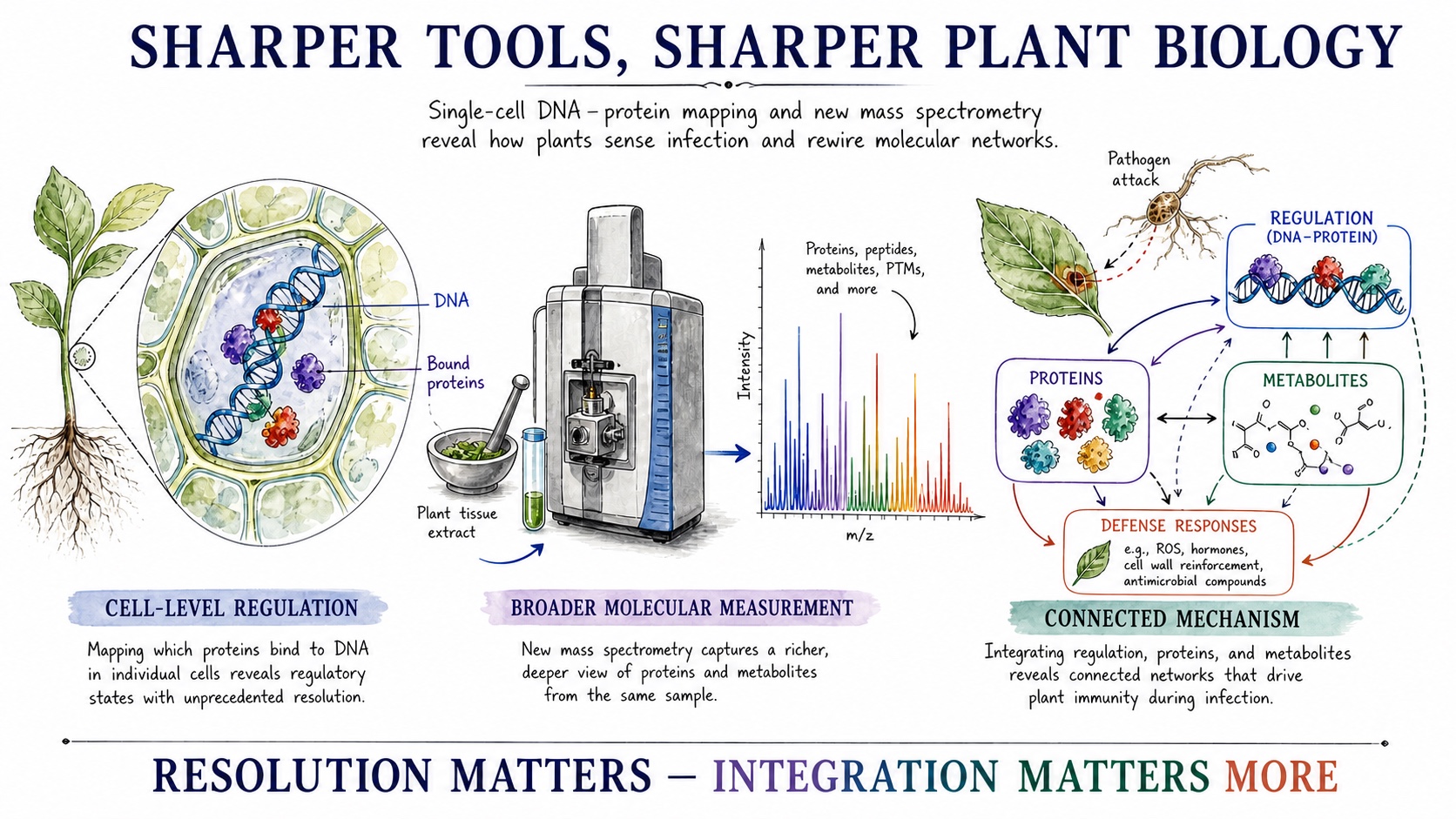
Multi-omics often gets discussed as a broad promise, but progress usually comes from better tools. Today's updates fit that pattern. One report highlights a new single-cell method for mapping DNA-protein interactions, and another focuses on a mass spectrometry platform designed to support multi-omics research. Neither story is about grapevine disease directly, but both matter for how we study plant-pathogen interactions with more precision.
Why this matters
In plant pathology, we still face a basic problem: infection is uneven across tissues and cell types. A virus does not affect every cell in the same way, and host responses are rarely uniform. In grapevine virology, this is especially relevant because disease symptoms, viral load, vascular restriction, and stress responses can vary across organs and developmental stages. Bulk measurements average that complexity away.
That is why single-cell and high-resolution analytical methods matter. If we want to understand how a host responds to infection, or why one cultivar tolerates a pathogen better than another, we need to connect several layers of biology: gene regulation, protein abundance, metabolite shifts, and tissue context. Multi-omics is useful only when each layer is measured well enough to support integration.
The two source items point to that practical reality. A single-cell DNA-protein interaction method can improve our view of regulatory control, which sits upstream of many transcript and phenotype changes. A newer mass spectrometry platform can improve the depth and speed of molecular profiling, which affects how well we capture proteins, metabolites, and related signals. For researchers working on plant health, food systems, and disease management, these are not side issues. They shape what questions can be answered with confidence.
What changed today
The first update, from Weill Cornell Medicine, reports a breakthrough single-cell method for mapping DNA-protein interactions. At a high level, the significance is straightforward: it aims to reveal how proteins interact with DNA at single-cell resolution, rather than relying only on pooled measurements across many cells. That matters because DNA-protein interactions are central to gene regulation. When measured cell by cell, they can expose hidden heterogeneity in regulatory states.
For plant researchers, the immediate implication is conceptual rather than direct. We are seeing continued movement toward methods that can resolve regulatory biology at the level where biological variation actually happens. In host-pathogen systems, that could help distinguish infected cells, neighboring responsive cells, and unaffected cells within the same tissue. It could also sharpen studies of developmental context, which is often a confounder in perennial crops such as grapevine.
The second update, covered by SelectScience, describes the Waters Xevo MRT P10 mass spectrometer as a tool that boosts multiomics research. The article is product-focused, so the right reading is cautious: this is not the same as a peer-reviewed demonstration across many biological systems. Still, the direction is important. Multi-omics depends heavily on analytical throughput, sensitivity, and reproducibility. Instrument advances can change what is feasible in routine experiments, especially when sample amount is limited or when researchers need broad molecular coverage.
Taken together, these updates show two ends of the same pipeline. One improves regulatory mapping at the single-cell level. The other aims to improve molecular measurement across omics workflows. The gap between them is where much of current biology sits: how to move from precise measurement to biologically meaningful integration.
My research angle
My interest is in grapevine virology and plant-pathogen interactions, with a focus on how multi-omics can move from descriptive datasets to useful biological models. These updates reinforce a point I keep returning to: resolution matters, but integration matters more.
In grapevine virus research, transcriptomics has been valuable, but it often leaves open questions. Are observed expression changes driven by a subset of infected cells? Are they linked to altered chromatin or transcription factor occupancy? Do they correspond to shifts in defense metabolites, phloem function, or protein turnover? Without connecting those layers, we risk over-interpreting bulk signals.
A single-cell DNA-protein interaction method is appealing because it could, in principle, help identify regulatory states associated with infection, recovery, or tolerance. In perennial woody plants, that is technically hard. Tissue dissociation, cell wall constraints, and low-input material remain real barriers. So I do not see this as a tool that immediately drops into grapevine labs. I see it as a sign of where the field is moving: toward finer mapping of regulation in complex tissues.
The mass spectrometry update is more immediately relevant. Better instrumentation can support proteomics and metabolomics workflows that are already central to plant disease studies. For grapevine systems, that could mean improved detection of host defense compounds, stress markers, viral response signatures, or treatment-associated changes. It also matters for translational work, where links to plant health and food quality become important.
I am also interested in how these advances might intersect with nanoencapsulation and disease management. If new delivery systems are developed for antiviral compounds, elicitors, or RNA-based treatments, multi-omics will be essential for evaluating their effects. We need to know not only whether a treatment reduces symptoms, but also how it changes host regulation, metabolism, and unintended stress responses. Better analytical tools make that evaluation more realistic.
One caution is worth stating clearly. Tool announcements can create excitement before biological validation catches up. A new method or instrument is not automatically a new insight. For plant science, the real test is whether these technologies work in difficult tissues, under realistic experimental designs, and with enough reproducibility to support comparisons across cultivars, pathogens, and environments.
Still, I think today's updates are worth tracking. They point toward a future where plant-pathogen research can ask sharper questions: which cells change first, which regulatory programs are engaged, and which molecular outputs best predict disease progression or resilience. That is the kind of multi-omics that could genuinely improve disease biology and management.
References
From Point Clouds to Pathogens: What New Plant Research Suggests for Smarter Grapevine Disease Work
NextFrom Peach Defense Chemistry to Grapevine Sensing: What This Week Reveals About Smarter Plant Disease Management
Related Articles
From Peach Defense Chemistry to Grapevine Sensing: What This Week Reveals About Smarter Plant Disease Management
6 min read
From Point Clouds to Pathogens: What New Plant Research Suggests for Smarter Grapevine Disease Work
6 min read
Cross‑Kingdom RNAs: The Plant Pathogen Trick We’re Only Just Catching
5 min read