From Point Clouds to Pathogens: What New Plant Research Suggests for Smarter Grapevine Disease Work
Recent papers on grapevine structure extraction, pruning automation, plant water-status biomarkers, and pathogen ecology point toward a more integrated way to study vineyard health. For grapevine virology, the common thread is clear: better phenotyping and ecological context can sharpen how we track stress, infection, and management outcomes.

Prem Pratap Singh
May 28, 2026 · 6 min read
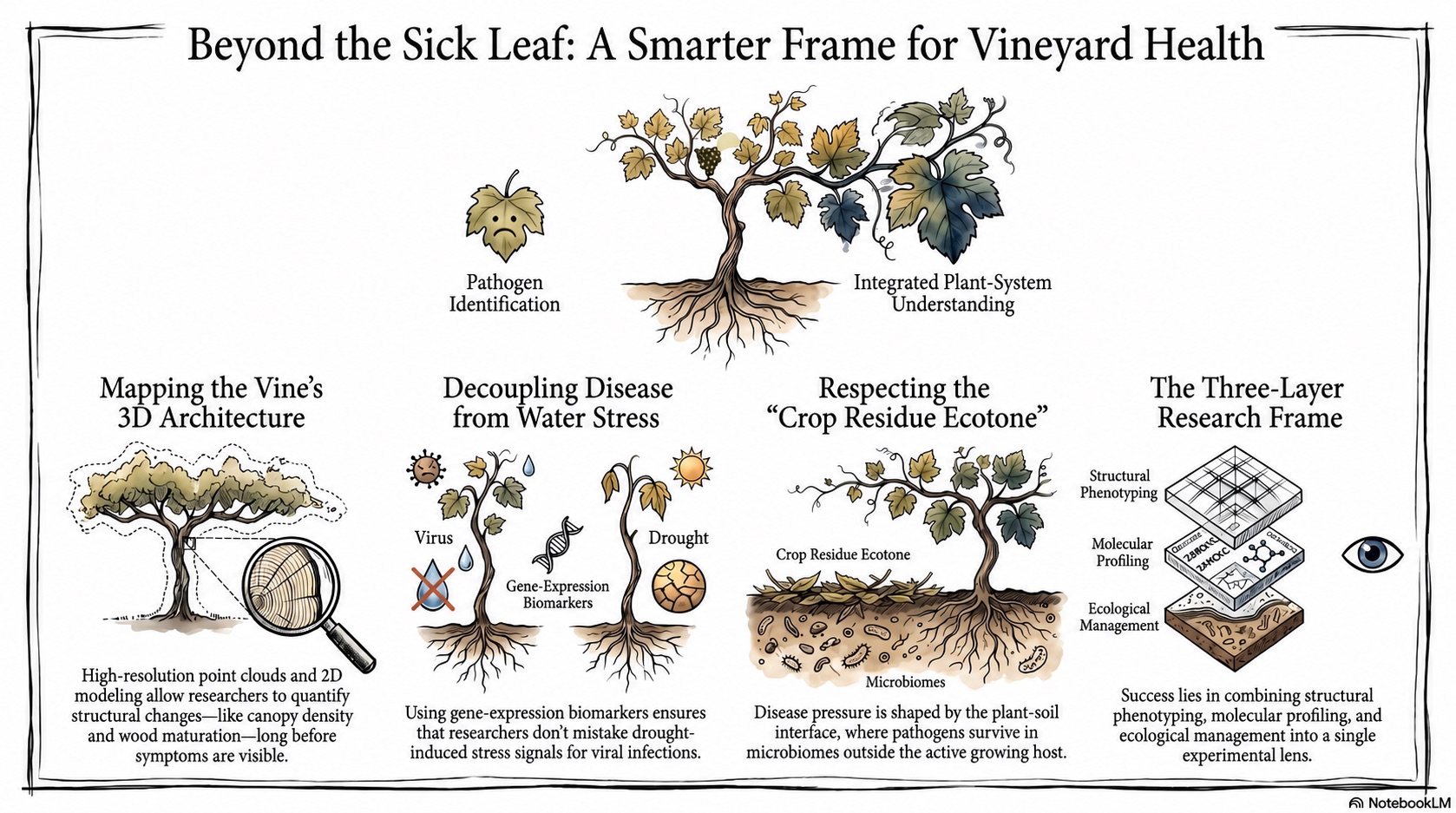
A useful pattern is showing up across plant research: better measurement is changing the kinds of biological questions we can ask. The papers I read today are not all about viruses, but together they point to a practical direction for grapevine disease research. If we can capture vine structure accurately, detect management-relevant traits automatically, and interpret plant stress in ecological context, then disease studies can move beyond simple infected versus healthy comparisons.
Why this matters
In grapevine virology, one of the recurring problems is separation of signals. A virus can change growth, canopy density, berry development, and stress responses, but drought, pruning history, rootstock effects, and microbial context can also shift those same traits. That makes field interpretation hard.
Two of the sources focus on grapevine architecture and pruning-related phenotyping. On the surface, that sits outside virology. In practice, it matters a lot. Viral disease often expresses through altered vigor, shoot development, wood maturation, and canopy organization. If those traits can be measured in a reproducible way from images or point clouds, then disease phenotyping becomes less subjective.
The other sources add the missing biological context. A gene-expression biomarker for plant water status shows that stress can be tracked molecularly across controlled and natural environments. Work on crop residue microbiomes and pathogen survival reminds us that disease pressure is shaped by the plant-soil interface and by survival outside the actively growing host. A study on spatial scale and pathogen reproductive fitness reinforces a basic point for field pathology: what we observe depends on the scale at which host and pathogen interact.
Taken together, these papers support a more careful research design for vineyard health studies, especially when the goal is to understand plant-pathogen interactions rather than just score symptoms.
What changed today
The clearest technical advance comes from recent work on 3D grapevine structure extraction from high-resolution point clouds. The paper presents a pipeline for recovering grapevine structure from detailed 3D data, which is important because woody perennial crops are hard to model. Grapevines have occlusion, irregular branching, seasonal variation, and training-system effects. Better extraction of structural traits could improve how we quantify architecture over time, and that opens the door to linking vine form with disease status, productivity, and management history.
A related earlier study on winter pruning automation looks at potential pruning-point detection through 2D plant modeling and grapevine segmentation. The immediate application is automation, but the broader value is trait standardization. Once segmentation and structural interpretation become reliable, the same workflows can support disease phenotyping, vigor assessment, and treatment-response studies.
Outside grapevine-specific imaging, the gene-expression biomarker for plant water status is a good reminder that molecular readouts can travel across environments if they are chosen carefully. The paper reports a biomarker based on gene expression that indicates water status in both controlled and natural settings. For anyone working on grapevine viruses, this matters because water deficit can amplify or mask disease-associated responses. A transcriptomic signal interpreted without water-status context can be misleading.
The ecology papers sharpen the field perspective. The article on microbiomes and pathogen survival in crop residues frames residues as an ecotone between plant and soil. That is a useful concept for perennial systems too, even if the residue dynamics differ from annual crops. It pushes us to think beyond the infected plant and ask how microbial communities and survival niches shape inoculum pressure and disease carryover. The paper on spatial scales and reproductive fitness of plant pathogens adds another layer: pathogen success is scale-dependent. That has direct implications for vineyard sampling, block-level inference, and how we interpret patchy symptom expression.
My research angle
My main takeaway is not that these papers solve grapevine virology. It is that they suggest a stronger experimental frame for it.
I am particularly interested in combining three layers:
- Structural phenotyping, using 2D and 3D imaging to quantify vine architecture, pruning outcomes, and canopy organization.
- Molecular profiling, especially transcriptomics and other multi-omics approaches that can separate infection-associated responses from drought or developmental effects.
- Management and ecological context, including pruning regime, residue handling, microbial background, and spatial sampling design.
This is where multi-omics becomes more useful, not less. Omics alone often produces long candidate lists and weak field transfer. But when paired with architecture-aware phenotyping and clear management metadata, it becomes easier to ask targeted questions. For example: does a virus-associated transcriptomic signature still hold after accounting for water status and vine structure? Do infected vines show consistent architectural deviations before visible symptoms? Can pruning-history or canopy traits explain part of the variance that is otherwise assigned to infection?
There is also a practical angle for disease management. If imaging pipelines can detect structural changes early, they may help prioritize vines for molecular testing. If water-status biomarkers can flag confounding stress, they can improve interpretation of virome or host-response datasets. If pathogen ecology is considered from the start, then management recommendations can be framed at the right spatial scale, from individual vine to row to block.
For my own work, this reinforces a simple principle: disease studies in perennial crops should be designed as integrated plant-system studies. Grapevine viruses act within a host that is shaped by pruning, water status, architecture, and microbial surroundings. Ignoring those layers makes results harder to reproduce and harder to apply.
The next step I would like to see is a field study that combines high-resolution vine structure capture, targeted molecular stress markers, and pathogen diagnostics in the same vineyard blocks across time. That kind of dataset would be well suited for grapevine virology, plant-pathogen interactions, and eventually precision management. It would also create a stronger bridge between descriptive phenotyping and actionable disease decisions.
References
- Accurate 3D Grapevine Structure Extraction from High-Resolution Point Clouds
- Grapevine Winter Pruning Automation: On Potential Pruning Points Detection through 2D Plant Modeling using Grapevine Segmentation
- A biomarker based on gene expression indicates plant water status in controlled and natural environments
- Microbiomes and pathogen survival in crop residues, an ecotone between plant and soil
- The effect of spatial scales on the reproductive fitness of plant pathogens
- Speciation due to hybrid necrosis in plant-pathogen models