From Orchard Lesions to Airborne Spores: Building Better Plant Disease Signals
Recent studies show how images, spore monitoring, microbiomes, metabarcoding, and phenotyping could support earlier plant disease decisions without losing biological context.

Prem Pratap Singh
July 14, 2026 · 5 min read
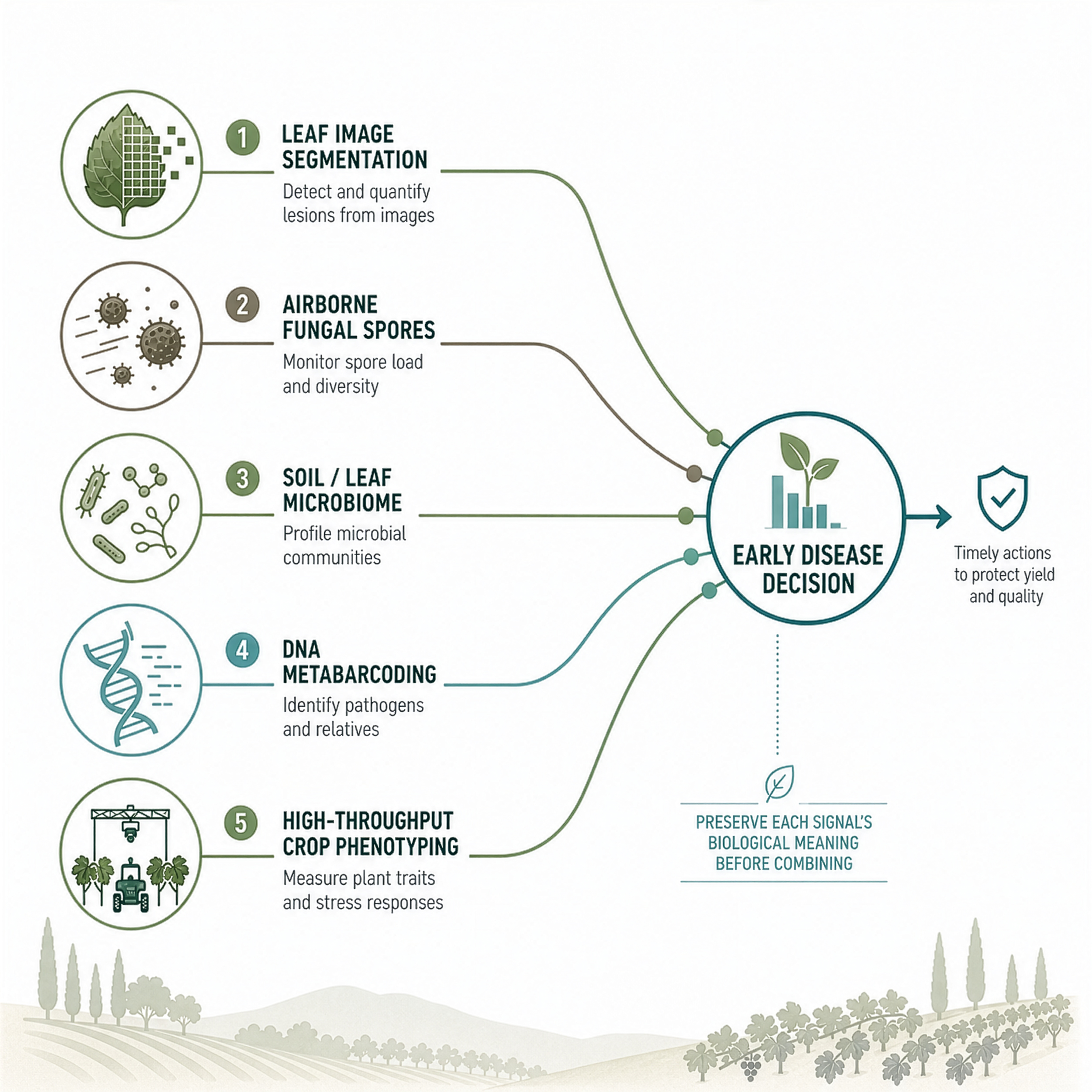
Plant disease research is moving toward linked measurements rather than isolated diagnoses. In this July 2026 literature snapshot, I see image segmentation, airborne spores, microbiome surveys, metabarcoding, and high-throughput phenotyping converging on one practical question: how can we detect risk early enough to guide a biological or breeding response? These studies do not yet provide one integrated system. However, together they clarify which measurements are becoming useful and where biological resolution remains the limiting step.
Why this matters
Plant disease decisions depend on timing, but latent infection can escape traditional detection. A recent systematic review analyzes 22 machine-learning studies from 2010 to 2025 across detection, classification, and forecasting, while identifying proactive diagnosis as the central need. This matters because a model can classify visible symptoms correctly and still arrive too late for prevention. In orchards, the problem is also visual: apple lesions may have low contrast, while overlapping or occluded leaves can leave incomplete features for segmentation.
Biological context matters just as much. In vineyard plots with historically low downy mildew impact, researchers found several fungal and bacterial species enriched in leaves and soil. Because downy mildew is caused by the oomycete Plasmopara viticola, these organisms are promising candidates for antagonist consortia, not confirmed controls. The measured enrichment is the observation; antagonism is the proposed function; field protection remains the inference to test. Association can guide isolation and testing, but it does not establish suppression under vineyard conditions.
What changed today
The clearest change is that disease signals are becoming more varied and more specific. One wheat study develops variety-dependent models that combine airborne spore monitoring with susceptibility and a statistical treatment of hierarchical panel data. WheatAI v1.0 addresses a complementary bottleneck: low-cost, high-throughput measurement of spike and spikelet counts, Fusarium head blight (FHB), Fusarium-damaged kernels (FDK), and stomatal traits. These are not interchangeable measurements. Spores describe exposure, symptoms describe disease expression, and plant traits provide host context.
The LViM study places language-infused visual segmentation against complex orchard backgrounds, but the available abstract excerpt does not report performance results. At the microbial level, Spanish cereal research highlights a different resolution problem. The universal internal transcribed spacer 2 (ITS2) marker can characterize fungal communities, but the abstract states that it cannot reliably separate closely related species with different toxigenic profiles. This limitation matters for Fusarium graminearum and host range evolution questions, where species-level assignment must come before ecological interpretation.
A second shift concerns intervention and translation. Gene editing can create plant traits by changing DNA at specific sites, and many countries regulate these plants more leniently than transgenic genetically modified organisms. The review also notes regulatory proposals in the European Union, without resolving their eventual market pathway. Meanwhile, research in industrial Aspergillus terreus links RNA interference (RNAi) machinery and microRNA-like RNAs to lovastatin biosynthesis; disruption produced different phenotypic consequences in two industrial strains. This suggests that fungal biosynthetic regulation may be strain dependent, although the abstract does not establish how broadly the mechanism applies.
My research angle
What I take from this is a design principle for multimodal AI biology: preserve the meaning of each signal before combining signals. Images can localize visible tissue damage, spore measurements can estimate exposure, metabarcoding can profile communities, and phenotyping can quantify host responses. A plant foundation model or digital agriculture AI system should not flatten these into one label. I would instead test whether each modality adds predictive information across varieties, environments, and disease stages, with uncertainty reported at each step.
For my own work, the biological follow-up is equally important. Microbes enriched in low-mildew vineyards need isolation, direct antagonism assays, and validation in plants before they become credible consortia. Fusarium surveys need markers that resolve species with distinct toxin profiles before supporting claims about host range. The A. terreus study also raises a synthetic biology question: can programmable gene expression probe biosynthetic gene cluster regulation without assuming that two strains respond alike?
In practice, agricultural robotics could standardize image and sample collection, but these sources do not test that integration. I would want the next study to connect field sampling, species-resolved biology, and prospective disease prediction in the same experiment. The current work gives us stronger components. The open question is whether they retain value when combined across seasons and real crop environments.
References
- LViM: Language-Infused Visual Mamba for apple leaf pests and diseases precise segmentation in complex environments
- Exploration du microbiote pour identifier des antagonistes du mildiou de la vigne
- Metabarcoding Characterization of Fungal Communities in Spanish Cereals with a Special Focus on Fusarium Species
- Market introduction of plant varieties and products with gene-edited traits
- Investigating the Susceptibility of Winter Wheat Varieties to Foliar Diseases Using Data-Driven Models
- Machine learning models for plant fungal disease detection and risk prediction: A systematic review
- WheatAI v1.0: An AI-Powered High Throughput Wheat Phenotyping Platform
- The RNAi machinery regulates lovastatin biosynthesis via microRNA-like RNAs in industrial Aspergillus terreus