From Xylem Recovery to Genome Mining: Connecting Plant Disease Biology Across Scales
New studies on Xylella, grapevine endophytes, fungal metabolites, and orchard imaging show why precision plant protection must connect host responses, transmission, chemistry, and detection.

Prem Pratap Singh
July 16, 2026 · 5 min read
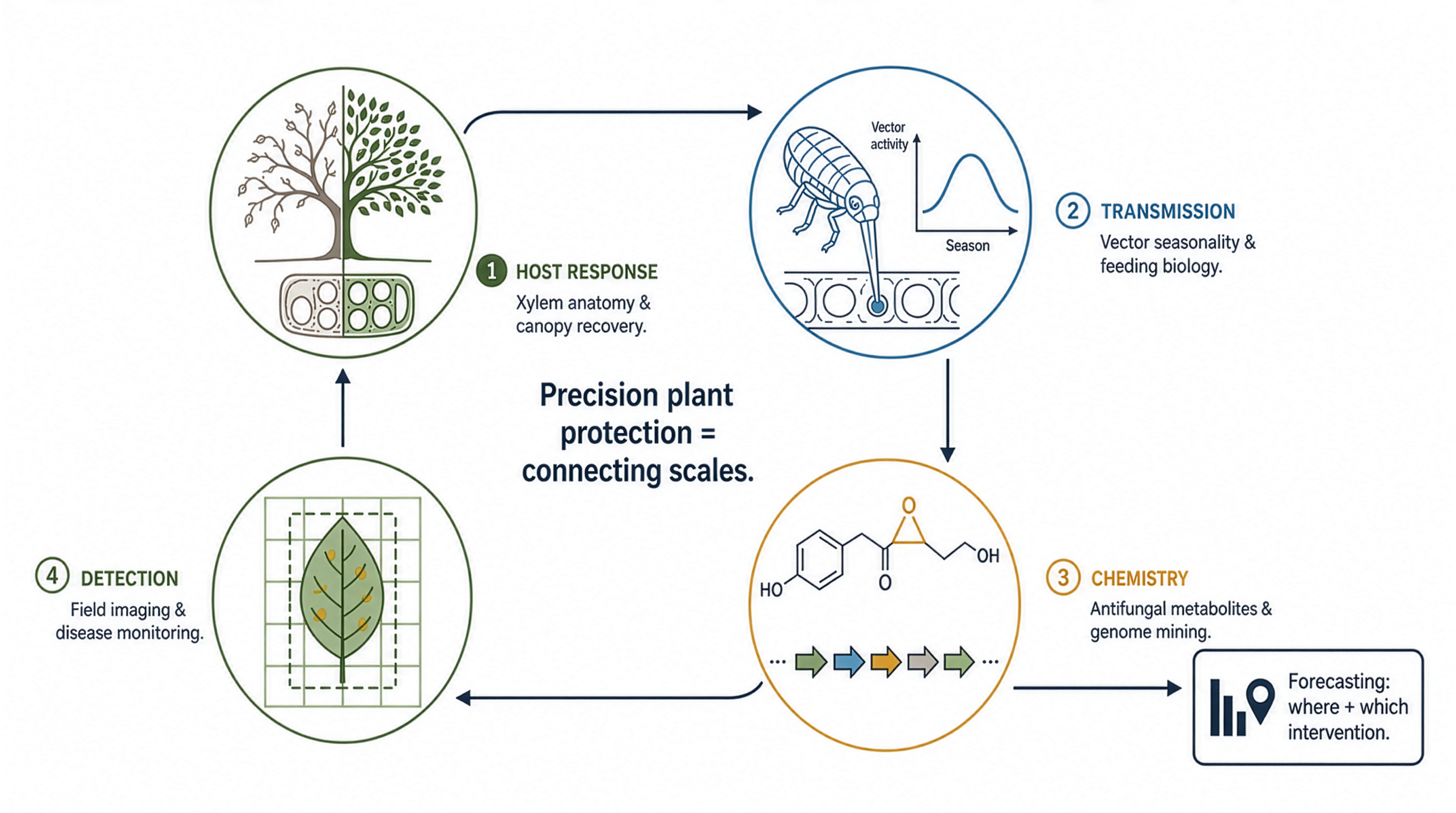
Plant disease control often treats detection, transmission, host response, and protective chemistry as separate problems. This week's reading connects those layers through Xylella fastidiosa in olive, its spittlebug vector, endophyte delivery in grapevine, antifungal metabolites, biosynthetic gene clusters, and orchard imaging. The studies do not form a single control program. However, together they show where precision plant protection needs stronger biological evidence.
Why this matters
A disease-management tool is only as useful as the biological process it measures or changes. For Xylella fastidiosa subsp. pauca (Xfp), the immediate context is severe: the bacterium has destroyed olive cultivation in Salento and is moving northward. Cellina di Nardò is described as highly susceptible, yet some naturally infected plants have recently shown spontaneous canopy restoration. Researchers therefore investigated xylem morphological changes after long-term infection.
The observation is important, but its meaning remains uncertain. Canopy restoration was seen in infected plants, and the study examined anatomical changes resembling a response to drought. This association suggests that xylem structure may contribute to how some susceptible trees persist, but the available abstract does not establish the mechanism. For disease forecasting, this distinction matters. Visible decline and later recovery may not describe pathogen status, anatomical adaptation, and future transmission risk in the same way.
Transmission adds another layer. In Europe, X. fastidiosa is mainly transmitted by the spittlebug Philaenus spumarius. A compartmental model now represents vector seasonal dynamics explicitly, while a separate study reconstructs the nymphal feeding apparatus in three dimensions. Nymphs face strong mechanical and nutritional constraints when extracting xylem sap under negative pressure. Linking seasonal models with feeding biology could therefore help researchers ask more precise questions about when transmission chains might be interrupted.
What changed today
The main change in today's reading is a clearer movement from broad disease labels toward measurable processes. The olive work focuses on long-term xylem anatomy rather than susceptibility alone. The vector studies focus on seasonal population dynamics and the specialized structures used for xylem feeding. These are different scales, but both can sharpen the biological assumptions behind Xylella management.
In grapevine, researchers developed a stem-injection method for introducing Pseudomonas chlororaphis M71 and Trichoderma atroviride SC1 into rooted and grafted plants. They compared spatial and temporal colonization patterns with a dye tracer because establishment, persistence, and movement through woody tissues remain poorly understood. The method provides a way to investigate delivery. However, the abstract does not justify assuming that injection alone produces persistent colonization or disease protection.
The chemistry studies offer equally specific starting points. Four nigroepocins and the known compound clavatol were isolated from Nigrospora sp. SN56127 and assessed against Fusarium graminearum. Nigroepocins A to D each contain a three-membered epoxy ring, described as rare among compounds isolated from Nigrospora. Their title reports antifungal activity, although the available abstract does not provide effect sizes.
A second study approached antifungal discovery through genome mining. Brevibacillus brevis B011, an endophyte from tobacco roots, had unresolved metabolites behind its antifungal phenotype. Researchers predicted 13 biosynthetic gene clusters, including nonribosomal peptide clusters for edeine, tyrocidine, and gramicidin, then used knockout and analytical experiments. The study title identifies leucine analogs of tyrocidines and tryptocidines discovered through genome mining and in vitro biosynthesis.
My research angle
What I take from this is that sustainable crop protection needs tighter connections between observation and intervention. For Xylella, I would connect host anatomy, vector seasonality, and feeding biology before interpreting canopy recovery as resistance. For grapevine endophytes, I would first establish where introduced organisms move and persist, then test whether that distribution corresponds with protection.
The apple leaf segmentation study reinforces the same principle from a detection perspective. Orchard images contain low lesion contrast, overlapping leaves, and occlusion, all of which hinder precise segmentation. Although this study concerns apple rather than downy mildew, the stated challenges are directly relevant to designing field-ready disease-monitoring questions.
For Fusarium graminearum, the metabolite and genome-mining studies provide candidates and biosynthetic routes rather than complete crop-protection solutions. Further work is needed to validate activity, delivery, persistence, and plant compatibility under relevant conditions. My open question is simple: how can these measurements be combined into a forecasting system that identifies not only disease presence, but also the most biologically appropriate intervention point?
References
- Resisting Xylella fastidiosa: xylem anatomical changes in the susceptible olive cultivar Cellina di Nardò after long-term infection
- Nigroepocins A-D: Antifungal Polyketides from Nigrospora sp. SN56127 with Activity against Fusarium graminearum
- Endophytic colonization pathways of Pseudomonas chlororaphis M71 and Trichoderma atroviride SC1 in grapevine following stem injection
- 3D reconstruction of the nymphal feeding apparatus of Philaenus spumarius
- LViM: Language-Infused Visual Mamba for apple leaf pests and diseases precise segmentation in complex environments
- Discovery of leucine analogues of tyrocidines and tryptocidines from Brevibacillus brevis B011 through genome mining and in vitro biosynthesis
- A compartmental model for Xylella fastidiosa diseases with explicit vector seasonal dynamics