From Almond Resistance to Fluorescent Lettuce: Connecting Host Biology with Earlier Disease Detection
New studies connect Xylella resistance, downy mildew fluorescence, pathogen niche responses, and vector biology. Together, they show why plant disease research needs integrated host, pathogen, and transmission measurements.

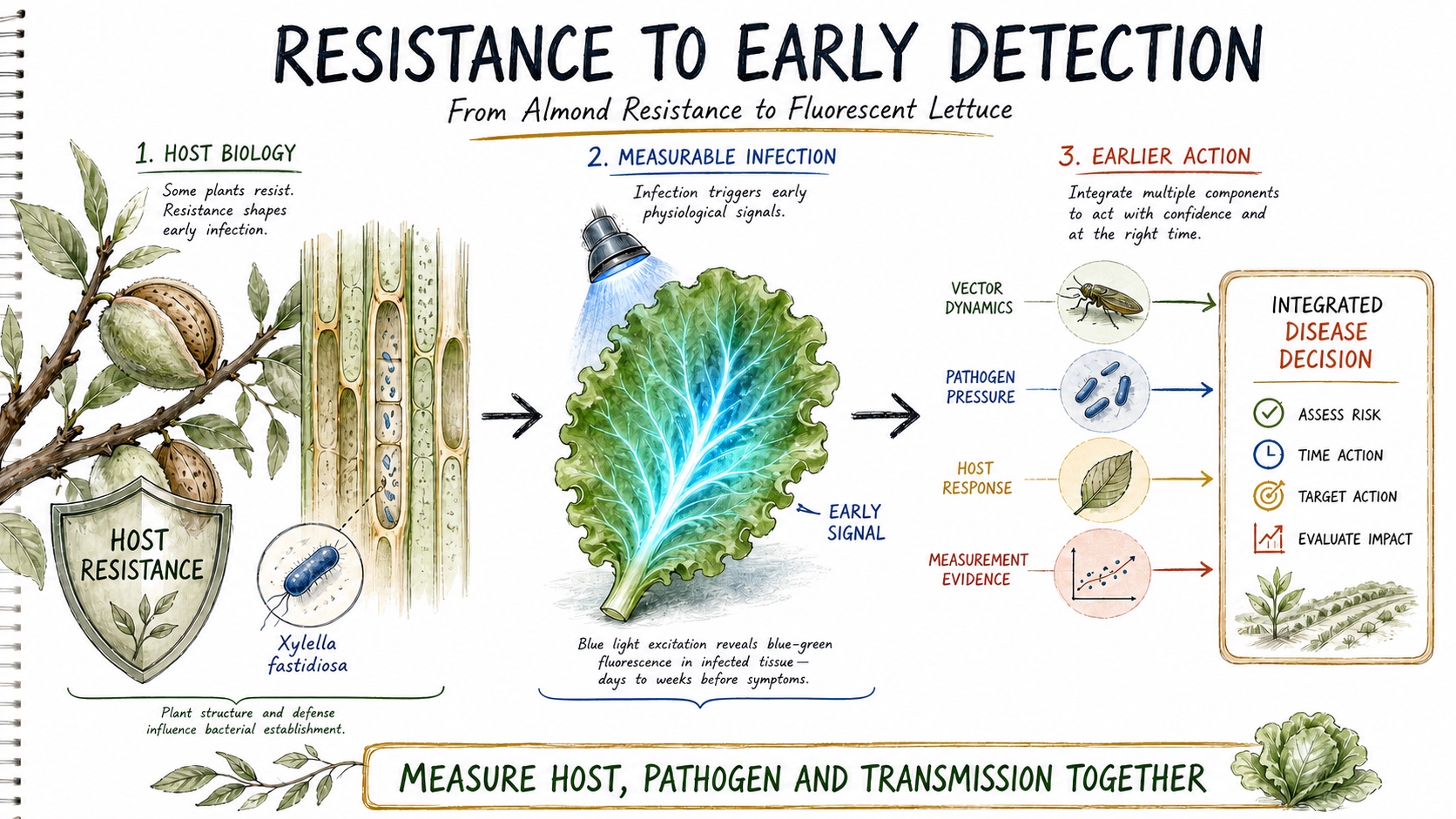
Plant disease research often separates host resistance, pathogen behavior, vector biology, and phenotyping. Today's papers support reading these areas together. In almonds and lettuce, the practical question is not simply whether symptoms appear. It is how early we can detect infection, how host background changes the outcome, and how that information can guide experiments without exceeding the evidence.
Why this matters
Xylella fastidiosa (Xf), a bacterium restricted to water-conducting xylem tissue, causes disease in several agricultural crops. Almond leaf scorch associated with X. fastidiosa subsp. fastidiosa sequence type 1 was first identified in Israel in 2017. The available abstract states that infected almond trees currently have no effective cure, so management relies mainly on uprooting infected trees. Under these conditions, identifying resistant plant material becomes especially relevant.
A new almond study reports the identification of a resistant cultivar and examines host-specific bacterial behavior. The title establishes those findings, although the available abstract does not provide the cultivar name or the underlying resistance mechanism. Therefore, the result should be treated as an entry point rather than a completed explanation. Resistance may reflect restricted bacterial establishment, altered host susceptibility, or another process, but those possibilities require direct validation.
Disease measurement presents a related challenge. Visual scoring can be inaccurate and inefficient, particularly for lettuce downy mildew caused by the obligate biotroph Bremia lactucae. Researchers observed patches of increased blue-green fluorescence (BGF) in infected lettuce under ultraviolet-A excitation. Because the study connects optical changes with transcriptional and metabolic responses, BGF may provide a measurable infection signal. However, its performance across cultivars, infection stages, and environmental conditions still needs assessment.
What changed today
The main change is not one isolated technology. It is the stronger connection between biological state and measurable phenotype. In lettuce, infection coincided with localized fluorescence rather than only a visually scored lesion. This observation provides the first step in a causal chain: infection changes host biology, those changes alter an optical property, and the optical signal may therefore help classify disease responses. The abstract supports the observation, while the wider diagnostic value remains an inference.
A parallel lesson comes from Xanthomonas perforans, a hemibiotrophic tomato pathogen. The leaf surface and internal apoplast impose different physiological constraints, and the study investigated how these environments program pathogen transcription. Its title reports spatiotemporal coordination among virulence, metabolism, and stress responses. This suggests that pathogen behavior cannot always be represented by one measurement taken from one tissue or time point. Where and when sampling occurs may change the biological interpretation.
For Xylella disease, the vector adds another layer. Philaenus spumarius feeds on xylem and is identified in the modelling study as a main Xf vector in Europe. A new three-dimensional reconstruction addresses the poorly understood feeding apparatus of its nymphs, which must extract nutritionally limited sap under negative pressure. Separately, a compartmental model explicitly includes vector seasonal dynamics. Together, these studies provide structural and population-level ways to examine transmission, but neither abstract establishes a specific control measure.
My research angle
What I take from this is that resistance studies should connect genotype, infection dynamics, and phenotype. For Xylella, I would first compare bacterial behaviour across resistant and susceptible almond backgrounds. I would then ask whether candidate host susceptibility genes or immune signalling pathways correspond with restricted colonization. The present sources do not identify those genes, so this remains a research question rather than a reported mechanism.
This same logic applies to downy mildew. BGF could become more informative if optical patches are aligned with pathogen distribution, host transcription, and metabolic state over time. Automated segmentation methods may help quantify disease regions, while complex field backgrounds, low lesion contrast, overlap, and occlusion remain relevant challenges, as described for apple leaf segmentation.
In synthetic biology, these measurements could eventually guide the design of synthetic promoters that respond to infection-associated signals or support precise immune receptor engineering. Yet, the current studies do not test such constructs. Gene editing can modify plant DNA at specific locations, and regulatory treatment differs among countries, with several applying more lenient rules than for transgenic genetically modified organisms. Biological performance and market introduction must therefore be evaluated as separate questions.
Collectively, these papers move plant disease research toward measurements that connect host response, pathogen state, and transmission context. For my work, the next step would be to test whether these signals predict durable resistance across environments. The open question is whether a phenotype that performs well in one host and setting will remain informative as pathogen populations, vectors, and field conditions change.
References
- Identification of an Almond Cultivar Resistant to Xylella fastidiosa subsp. fastidiosa and Insights into Host-Specific Bacterial Behavior
- Blue-Green Fluorescence for Downy Mildew Phenotyping in Lettuce: Linking Transcriptional, Metabolic, and Optical Changes
- Spatiotemporal coordination of virulence, metabolism, and stress responses shapes infection dynamics of Xanthomonas perforans
- 3D reconstruction of the nymphal feeding apparatus of Philaenus spumarius
- A compartmental model for Xylella fastidiosa diseases with explicit vector seasonal dynamics
- LViM: Language-Infused Visual Mamba for apple leaf pests and diseases precise segmentation in complex environments
- Market introduction of plant varieties and products with gene-edited traits
From Xylem Recovery to Genome Mining: Connecting Plant Disease Biology Across Scales
NextFrom Xylella Metabolism to CRISPR Alfalfa: Connecting Pathogen Biology, Vectors, and Plant Editing