Can Free Data Spot a Plant Disease Outbreak?
Anyone can download every public record of Xylella, a bacterium that killed millions of olive trees. I checked whether those free records actually noticed the outbreaks we know happened. Sometimes they did. Sometimes they missed completely.
August 1, 2026 · 3 min read
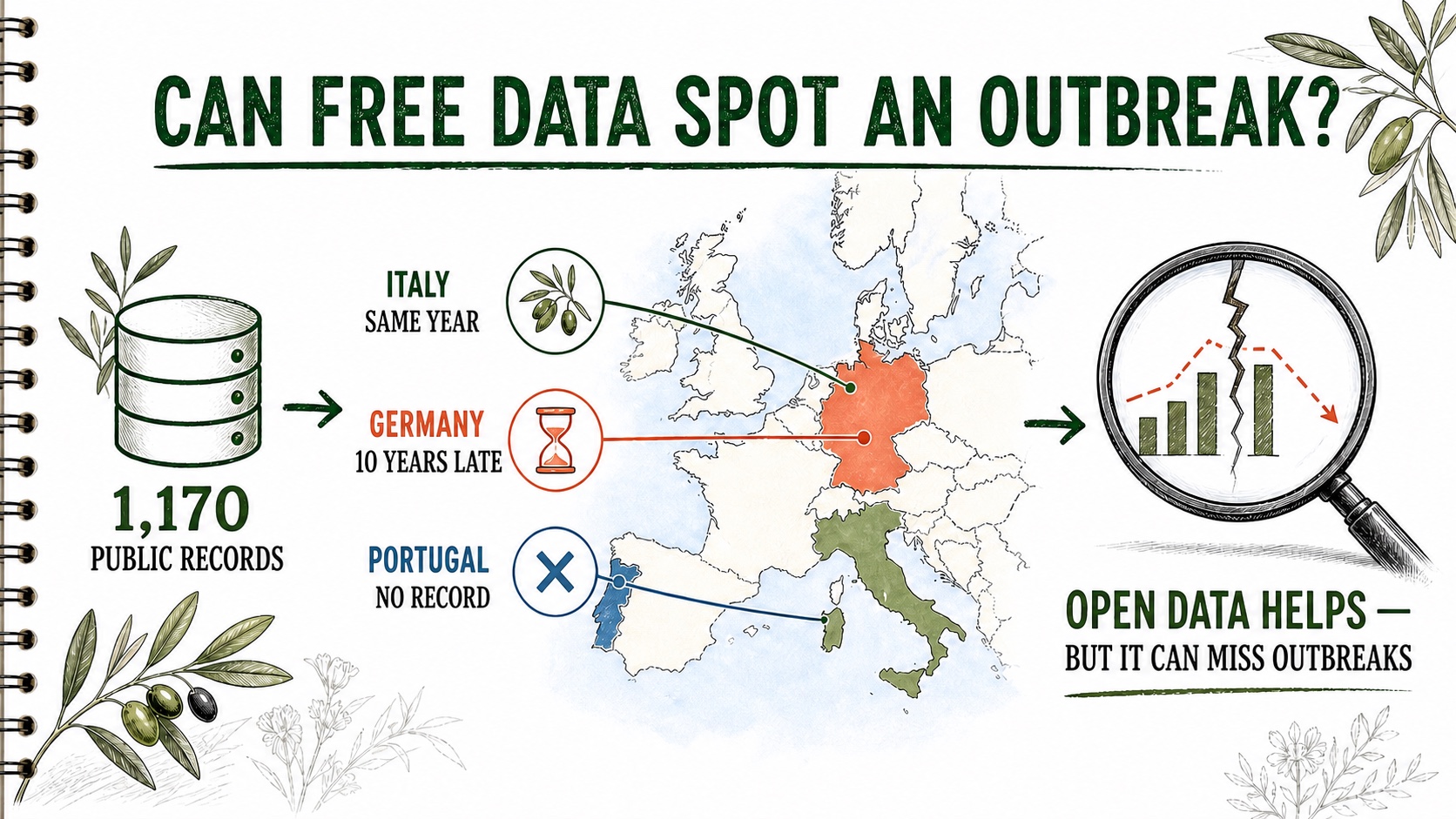
Xylella is a bacterium that killed millions of olive trees in southern Italy. It is under quarantine across Europe.
Anyone can download every public record of it, for free, in about a second.
So I asked a simple question: when those outbreaks happened, did the free data notice?
Guess before the graph
Which country's confirmed outbreak never appeared in the public records?
Choose one answer to reveal the result, then inspect the chart below.
What I checked
Europe has had five Xylella outbreaks in the last decade. We know exactly when each one was confirmed, because plant health authorities recorded the dates.
I compared those known dates against the first public record for each country.
What I found
Data-readiness check
Public data does not provide a consistent outbreak alert
Italy appears on time, Spain within one year, Germany a decade late, and Portugal is missing entirely.
Evidence detail
| Country | Confirmed | First public record | Timing |
|---|---|---|---|
| Italy | 2013 | 2013 | On time |
| Spain | 2016 | 2017 | +1 year |
| France | 2015 | 2012 | 3 years earlier |
| Germany | 2016 | 2026 | +10 years |
| Portugal | 2019 | No record | Missing |
Mixed results, and the mix is the point:
- Italy: recorded the same year the epidemic was confirmed. 2013.
- Spain: one year late.
- Germany: ten years late.
- Portugal: an outbreak in 2019, and still no record at all.
The two big, well-publicised epidemics showed up almost immediately. The two small ones did not.
What that means in practice
The free data can confirm a large outbreak. It cannot tell you a country is clean.
Germany's case was a single infected plant in a glasshouse that was destroyed. Portugal's outbreak was contained. Neither left a trace. If you had used this data to check whether Portugal had Xylella, you would have got the wrong answer.
The other trap: half the data is from one country
Nearly half of all records come from the United States.
That does not mean Xylella is worst there. It means the US publishes far more biodiversity data than anyone else.
I corrected for this by dividing each country's records by how many total records that country publishes.
Surveillance portfolio
Reporting effort reshapes the country ranking
The United States leads raw records but falls to seventh after normalizing for total GBIF publishing volume.
Normalized index · Xylella records per one million records published by that country
Evidence detail
| Country | Normalized index | Xylella records |
|---|---|---|
| Iran | 7.7 | 10 |
| Italy | 7.5 | 104 |
| Brazil | 2.2 | 96 |
| Argentina | 1.0 | 19 |
| China | 0.7 | 10 |
| United Kingdom | 0.5 | 122 |
| United States | 0.4 | 543 |
| Spain | 0.3 | 31 |
| France | 0.3 | 63 |
| Taiwan | 0.2 | 5 |
The United States drops from first place to seventh.
Italy rises near the top, which fits: Italy has Europe's worst epidemic. Brazil rises too, and Brazil has a long-running citrus epidemic. The corrected ranking matches what we already know about the disease. The raw one did not.
Where the map is empty tells you least
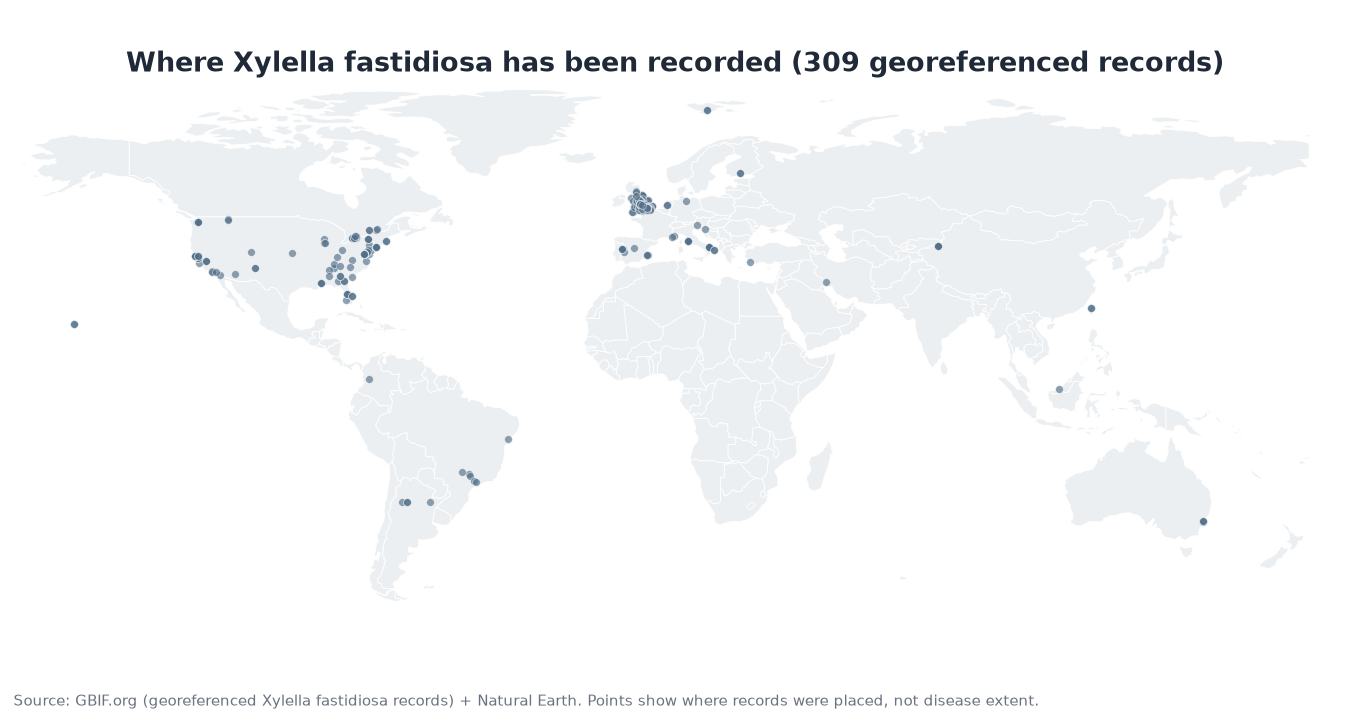
Only 309 records have coordinates. They cluster where surveillance programmes operate.
The blank areas are mostly places nobody has checked, not places the bacterium is absent.
What this does not prove
- These records show where people looked and found something. They do not measure how much disease exists.
- Iran tops the corrected ranking on only 10 records, which is too few to trust.
- France has a record three years before its outbreak, which I cannot explain from one data point.
Free occurrence data is genuinely useful for confirming a pathogen reached somewhere, and for deciding where to survey next. It just cannot answer "how bad is it" or "is this country safe".
The next step I would take is to add climate suitability. A country with the right climate, decent recording activity and almost no records would be the most interesting place to go looking.
How this was done
All 1,170 records came from the GBIF API, with a stamp recording the source, date and licence. Outbreak dates come from published European plant health reports and are stored as a separate file. Every figure here is made by the linked code.
Dataset
GBIF occurrence records for Xylella fastidiosa
Data accessed
August 1, 2026
Data terms
GBIF-mediated records retain their dataset-level CC0 or CC BY licences.
Records analyzed
1,170
Reproducible code
View analysis code